


%20(1).avif)
.avif)

No. iMessage is not HIPAA-compliant.
Indeed, iMessage uses end-to-end encryption between Apple devices. However, encryption addresses only part of HIPAA compliance.
Healthcare providers also need a business associate agreement, access controls, audit trails, retention rules, and documented procedures.
Thus, healthcare organizations should not use consumer iMessage for protected health information.
In this article, we discuss how iMessage falls short when it comes to HIPAA compliance. We also look at how iPlum provides a HIPAA-compliant alternative for regulated patient communication.
Table of Contents
1. How does iMessage encryption work?
2. Why isn't iMessage HIPAA compliant for patient communication?
3. What does HIPAA-compliant text messaging require?
4. How iPlum enables HIPAA-compliant messaging
5. How to move patient texts from iMessage to iPlum
6. Get iPlum instead of iMessage for patient texts
How does iMessage encryption work?
Apple encrypts an iMessage before it leaves the sender’s device.
The recipient’s registered Apple devices receive an encrypted copy and use a decryption key to open it. According to Apple’s Messages privacy information, Apple cannot read the message or its attachments as they travel through its servers.
However, the Messages app does not send every text through iMessage.
The app can also use SMS, MMS, or RCS, depending on the recipient’s device and available connection.
And because standard SMS does not encrypt message content, healthcare providers cannot assume every conversation inside Messages receives iMessage’s end-to-end encryption.
Storage creates another concern.
If you enable iCloud Backup or Messages in iCloud, conversations can sync across devices linked to the same Apple Account. You can also leave messages stored locally indefinitely.
As a result, a healthcare practice cannot apply a definite retention policy or deletion schedule to conversations in personal accounts.
Why isn't iMessage HIPAA compliant for patient communication?
iMessage is not HIPAA compliant for patient communication for several reasons, including:
Apple does not provide an iMessage BAA
A Business Associate Agreement (BAA) is mandatory under HIPAA.
Covered entities must execute a BAA before sharing PHI with a vendor acting as a business associate. Without a BAA, sharing PHI is a HIPAA compliance violation in that relationship.
Apple has a BAA for its specific Health app Data Share with Provider. However, Apple does not sign Business Associate Agreements for iMessage. That agreement does not extend to Messages conversations.
Encryption alone does not meet the HIPAA rules
End-to-end encryption is essential for HIPAA-compliant messaging, but it is one technical safeguard. Encryption alone does not meet all federal legal requirements for handling patient data.
The HIPAA Security Rule calls for technical and administrative safeguards protecting electronic PHI. Organizations must pair transmission security with administrative safeguards, physical protections, workforce procedures, and reviews.
Meanwhile, the Privacy Rule governs permitted uses and disclosures of PHI and requires reasonable efforts to limit PHI to the minimum necessary.
iMessage lacks organizational access and audit records
iMessage lacks the necessary audit trails and access controls required by HIPAA.
As a result, a practice cannot assign clinical roles, apply automatic logoff, or review comprehensive logging from personal Apple Accounts.
Remember, healthcare organizations must implement access controls for text messaging. Robust access controls grant each authorized user an account and restrict patient data access based on duties. Administrators should revoke access after a departure, lost device, or role change.
Audit trails are required for HIPAA-compliant text messaging platforms.
HIPAA mandates audit trails for all PHI communications, allowing an organization to examine system activity. Access controls must be implemented for HIPAA-compliant messaging, and the platform should record who viewed or sent each item.
Personal devices create operational exposure
The use of personal devices creates additional risks for healthcare communications.
A diagnosis or social security number can appear on linked computers and remain tied to a former employee's Apple Account.
In addition, push notifications can expose patient information on a locked screen. Unauthorized users may also gain access to messages through a shared or lost device, creating a data breach and compliance risk.
HIPAA does not regulate health information on an individual's personal devices after receipt. However, covered healthcare providers remain responsible for safeguarding PHI in their systems.
Recipient errors can disclose PHI
Misidentifying recipients poses a risk of impermissible disclosure. A clinician, for instance, can select the wrong contact, use an outdated number, or send PHI to a shared device.
That said, patient consent does not excuse careless disclosure.
The practice should verify the intended recipient, record communication preferences, and limit text communication to the minimum necessary.
Using iMessage for PHI poses legal and operational risks because the organization cannot manage these controls through its compliance program.
What does HIPAA-compliant text messaging require?
Text messages can be HIPAA-compliant when encrypted and accompanied by BAAs. However, the chosen technology must form part of a documented security and privacy process.
More specifically, HIPAA requirements apply when covered entities create, receive, maintain, or transmit PHI electronically.
Your phone system, therefore, must protect data during transmission and storage, and provide the organization with records showing how authorized users accessed and exchanged it during daily clinical operations.
For starters, HHS mandates safeguards, such as appropriate risk analysis, for the handling of electronic PHI.
A healthcare organization needs to perform a security risk analysis for the chosen technology under HIPAA. The review should examine identities, storage, message access, backups, transmission, and possible disclosures.
The key requirements for HIPAA-compliant texting follow:
- Encryption: Text messages must be encrypted to be HIPAA compliant under the organization's selected security measures. Text messaging platforms must provide encryption in transit and at rest.
- Vendor agreement: A Business Associate Agreement is required for PHI sharing with a vendor acting as a business associate.
- User management: Individual accounts, robust access controls, authentication, and automatic logoff restrict access to authorized users.
- Activity records: Audit logging and comprehensive logging record access, sending, deletion, and administrative changes.
- Recipient verification: Users must confirm the intended recipient before they communicate PHI.
- Retention: The organization needs a process for storing messages and retrieving records from secure messaging tools and patient portals.
- Incident response: Written breach notification procedures explain how the organization assesses and reports an impermissible disclosure or data breach.
- Workforce rules: Training, policy management, and sanctions establish acceptable text communication.
HIPAA requires reasonable technical safeguards and administrative safeguards rather than encryption alone.
Thus, a secure platform must serve the organization's wider compliance program.
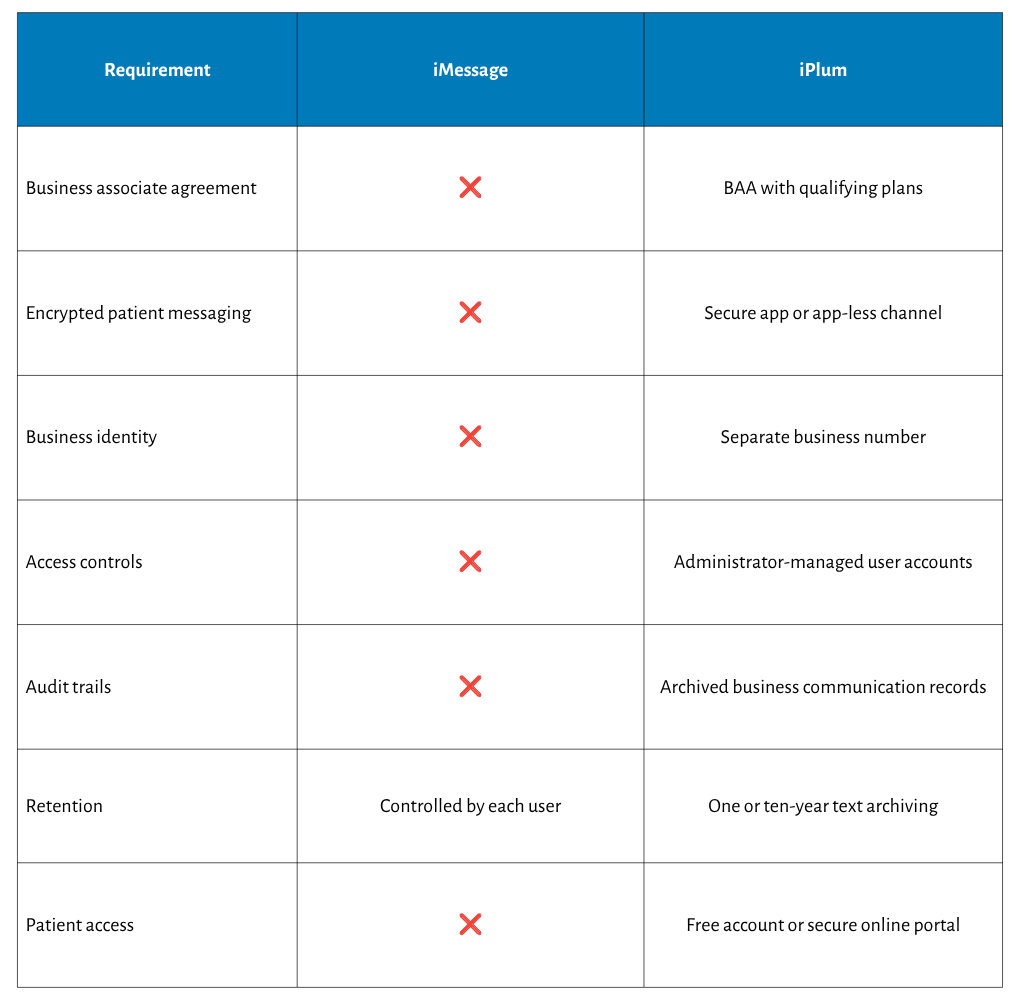
iMessage vs. iPlum for HIPAA-compliant communication
iMessage protects conversations between Apple devices, but it was built as a consumer messaging service. iPlum, in contrast, targets professional use in regulated industries.
The table below compares both services side by side regarding HIPAA compliance.
How iPlum enables HIPAA-compliant messaging
For secure communication, healthcare providers should use HIPAA-compliant secure messaging platforms.
Here's how iPlum's HIPAA texting and calling service helps healthcare providers meet HIPAA regulatory requirements.
It executes a Business Associate Agreement
iPlum provides a signed Business Associate Agreement with Professional and Enterprise plans. The contract defines how iPlum and the healthcare customer handle protected health information and respond to security incidents.
With iPlum, healthcare organizations can document the vendor relationship before they communicate PHI. The BAA also establishes responsibilities for safeguarding PHI and breach reporting.
It moves PHI into an encrypted channel
iPlum provides secure messaging through its mobile apps and web portal.
Patients can reply through a free iPlum account or an app-less online portal. That way, healthcare professionals can safely communicate with PHI rather than placing medical details in standard SMS.
Secure messaging separates encrypted clinical exchanges from ordinary text messaging. It also lets clinicians communicate efficiently through a defined business channel while protecting PHI.
It allows you to separate business and personal conversations
iPlum gives a clinician a dedicated business number on their existing smartphone.
As a result, patients see the business identity rather than a personal number. The line includes business hours, voicemail, text signatures, and automatic replies to set appropriate expectations for patient communication.
With these features, the practice can direct urgent concerns to emergency services and reserve routine messaging for appointments, follow-ups, referrals, and care questions.
It allows you to manage access centrally
With iPlum, administrators can create separate user accounts and change permissions when roles change. They can also remove business access after a user leaves or loses a device.
Such controls make message access easier to attribute. They also reduce the likelihood that PHI remains accessible through a former employee's personal Apple Account.
It allows you to archive healthcare communication
The iPlum Professional plan provides one-year text archiving. The Enterprise plan provides ten-year text and recording archiving for organizations with longer retention duties.
Archived conversations give administrators an accessible history for internal reviews, patient disputes, and compliance inquiries. Web calling and texting, voicemail transcription, scheduled messages, and templates add structure to daily healthcare communication.
How to move patient texts from iMessage to iPlum
Below is a quick overview of how to move patient texts from Apple’s iMessage to iPlum:
- Review current use: Identify clinicians who use personal numbers, Apple Accounts, or consumer messaging apps. Document where current conversations and attachments reside.
- Set up iPlum: Choose a plan and sign the BAA before users send PHI. Then configure individual accounts, business numbers, permissions, business hours, voicemail, and secure messaging.
- Create a messaging policy: Define permitted messages, response times, emergency instructions, patient consent procedures, recipient verification, retention periods, and escalation steps.
- Inform patients: Explain how to use the iPlum app or secure online portal. Remind patients to call emergency services rather than text urgent medical concerns.
- Test the configuration: Confirm user access, message archiving, automatic logoff, lost-device procedures, and breach notification processes before launching the new channel.
After the transition, use iPlum rather than personal numbers or Apple Accounts for patient texts. That said, iPlum does not replace medical records. Clinicians should transfer diagnoses, medication changes, treatment decisions, and follow-up actions into the EHR.
Frequently asked questions
Are blue iMessages HIPAA compliant?
No. Blue bubbles indicate iMessage encryption between Apple endpoints. They do not establish a BAA, organizational audit trails, retention settings, user permissions, or the other HIPAA standards required for PHI.
Can healthcare providers text patients under HIPAA?
Yes. Providers can use text communication in a HIPAA-compliant manner when they apply appropriate safeguards, verify recipients, document policies, obtain required agreements, and use an encrypted channel for PHI.
Does end-to-end encryption make an app HIPAA compliant?
No. End-to-end encryption protects data in transit, but HIPAA regulations also require access management, activity records, security reviews, workforce procedures, vendor agreements, and incident response processes.
Is iMessage HIPAA compliant when iCloud Backup is disabled?
No. Disabling iCloud backup does not add a BAA, administrator-managed access, audit trails, central retention, or comprehensive policy settings. iMessage remains a consumer service rather than HIPAA-compliant communication software.
What is a HIPAA-compliant alternative to iMessage?
iPlum is the best HIPAA-compliant alternative to iMessage. It provides HIPAA-compliant messaging, a separate business number, secure patient access, administrative account settings, a BAA, and text archiving on smartphones and computers used throughout the healthcare industry.
Get iPlum instead of iMessage for patient texts
Healthcare providers need a phone service that can protect sensitive health information in accordance with their security, privacy, and retention policies.
iPlum combines encrypted patient texting with a separate business number, administrator-managed accounts, message archiving, and a signed BAA.
With iPlum, clinicians can communicate efficiently while adhering to HIPAA privacy and security requirements.
Get started with iPlum to replace personal iMessage conversations with HIPAA-compliant communication designed for professional healthcare use.

