


%20(1).avif)
.avif)
RCS Universal Profile 3.0 marks an important change in mobile messaging.
It introduces interoperable end-to-end encryption for person-to-person RCS and adds richer business messaging options. However, a secure message is not automatically a compliant business record.
Encryption protects message content as it travels between approved endpoints. Regulated-message retention serves a different purpose.
A financial firm, insurance agency, healthcare practice, or law office may need to preserve conversations, supervise users, enforce retention periods, produce records, and prevent unauthorized deletion.
Consequently, an encrypted RCS thread can still become an off-channel communication. The decisive question is not only, “Can an outsider read the message?” A regulated organization must also ask, “Can we retain, review, search, and produce it?”
Below, you’ll learn why RCS encryption does not satisfy regulated-message retention, which archiving and supervision controls organizations still need, and how iPlum provides compliant communication for finance professionals.
Table of Contents
1. What changed with RCS Universal Profile 3.0?
2. What does RCS end-to-end encryption do?
3. Why encryption and retention are different controls
4. Controls regulated-message retention requires
5. RCS encryption versus regulated-message retention
6. Why regulated sectors need both controls
7. How iPlum adds retention and supervision to secure mobile communication
9. Secure messaging needs a compliant record behind it
What changed with RCS Universal Profile 3.0?
The GSMA released Universal Profile 3.0 in March 2025.
Its RCS encryption announcement describes a common end-to-end encryption framework based on Messaging Layer Security (MLS).
Earlier messaging clients could encrypt some RCS conversations through proprietary methods. Universal Profile 3.0 gives device makers, operators, and messaging providers a common foundation for encrypted person-to-person communication.
The release also adds richer business deep links, business-sender subscription controls, and audio-messaging changes.
However, the person-to-person encryption specification and the business messaging additions address different technical problems.
An organization should not assume that every RCS business message receives end-to-end encryption merely because a device displays an RCS label.
Implementation depends on compatible clients, devices, networks, and configurations. RCS fallback can also move a conversation to SMS or MMS.
Therefore, organizations must verify the channel used for regulated communication.
What does RCS end-to-end encryption do?
MLS establishes encryption keys for messaging endpoints.
The IETF’s MLS architecture says the protocol protects against eavesdropping, tampering, and message forgery. It also provides forward secrecy and post-compromise security.
In ordinary terms, authorized endpoints can decrypt the content, but network intermediaries should not be able to read it.
Encryption can protect confidential advice, account details, health information, legal discussions, attachments, and other sensitive material during transmission.
Those protections remain valuable. A secure transport layer can reduce exposure from interception and unauthorized modification.
Still, MLS does not define a firm's recordkeeping policy, supervisory workflow, archive search, legal hold, user permissions, or regulatory export process. The IETF architecture states that several parts of a complete messaging system remain with the application.
Encryption answers the question of who can read a message in transit. Retention answers what happens to the business record after users send or receive it.
Why encryption and retention are different controls
End-to-end encryption can coexist with compliant retention, but encryption does not create retention.
A good business phone system can store an authorized archival copy at an endpoint or through an enterprise-controlled process. The archive then needs its own security, integrity, access, and lifecycle controls.
A consumer message history does not meet that standard merely because it remains on a phone. The user can delete a thread, lose the device, change a number, or leave the organization. Supervisors may have no access. Exports may also omit content or metadata.
Regulated organizations need a record independent of a user's device. It must resist alteration and remain retrievable throughout the required period.
That way, local message history is a user feature. A regulated archive is an organizational control.
Controls regulated-message retention requires
The duties vary by sector and record type. However, seven controls commonly apply.
1. An approved business channel
An organization must define which numbers, apps, message types, and devices workers may use. Its policy should address RCS fallback, group messages, attachments, disappearing content, and personal numbers.
FINRA states that a firm planning to use a text or chat service must first confirm that it can retain required records. Therefore, encryption cannot turn an unapproved personal RCS thread into an approved firm channel.
A dedicated business number gives administrators a channel they can assign, monitor, reassign, or deactivate.
2. Automatic incoming and outgoing message archiving
Manual forwarding, screenshots, and periodic exports can miss replies, attachments, timestamps, edits, participant details, and deleted content.
Accordingly, an archive should preserve incoming and outgoing business messages automatically from the moment the organization authorizes the channel.
The archive should preserve sender, recipient, date, time, direction, attachments, and enough context to reconstruct the conversation.
3. Record integrity
Encryption protects content from interception and tampering during transmission. It does not prove that the stored copy remained unchanged throughout its retention period.
Financial recordkeeping rules address that separate concern.
The 2026 FINRA Annual Regulatory Oversight Report explains that broker-dealers using electronic recordkeeping can preserve records through non-rewriteable, non-erasable storage, commonly called WORM, or through the audit-trail alternative under Exchange Act Rule 17a-4(f).
Therefore, an archive should prevent unauthorized edits or deletion and document administrative activity.
4. A defined retention period
Encryption has no schedule tied to a regulation, record category, customer relationship, or legal hold. Device settings may delete content too early or retain it too long.
Organizations must classify records and apply the correct period. FINRA Rule 4511 uses a six-year default when no other period applies. Other rules set different periods.
Meanwhile, HIPAA does not impose one retention period for all patient messages.
The Security Rule requires certain compliance documentation to be retained for 6 years, but state laws and organizational policies may govern clinical message retention. Legal organizations may need case-based schedules and litigation holds.
5. Supervisory review
Financial firms need procedures that allow designated reviewers to examine communication for complaints, unsuitable statements, misleading claims, and prohibited activity.
FINRA's 2026 report defines off-channel communications as business messages sent or received through a tool the firm has not authorized and does not routinely archive, supervise, or retain. A secure personal conversation can meet that definition if the firm cannot review it.
Supervision, therefore, requires reviewer access, search criteria, sampling rules, escalation paths, and documented outcomes. RCS encryption provides none of those functions on its own.
6. Administrative access and user lifecycle management
Regulated communication must belong to the organization, not solely to the worker’s phone. Administrators need authority to manage accounts, permissions, passwords, departures, and business numbers.
Personal RCS uses the phone number and messaging client the user chooses. Even when the organization owns the phone, access to native messages may remain tied to the device. An employee departure can therefore leave the organization searching for records on a surrendered or remotely erased handset.
Central administration changes that outcome. The organization can manage the business identity and archive separately from the user's personal number and native message store.
7. Search, export, production, and legal holds
Regulators, courts, auditors, and investigators may request records by user, number, date, customer, or subject. The organization must retrieve readable content and relevant metadata.
An ordinary device export may produce incomplete threads, omit attachments, or require several phones. Moreover, local deletion can erase the only copy.
A regulated archive should offer centralized search, controlled export, audit logs, and a mechanism to suspend routine deletion when a legal hold is in effect. Encryption alone does not provide any of these functions.
RCS encryption versus regulated-message retention
The difference becomes easier to see when each technology is assigned a single, defined job.
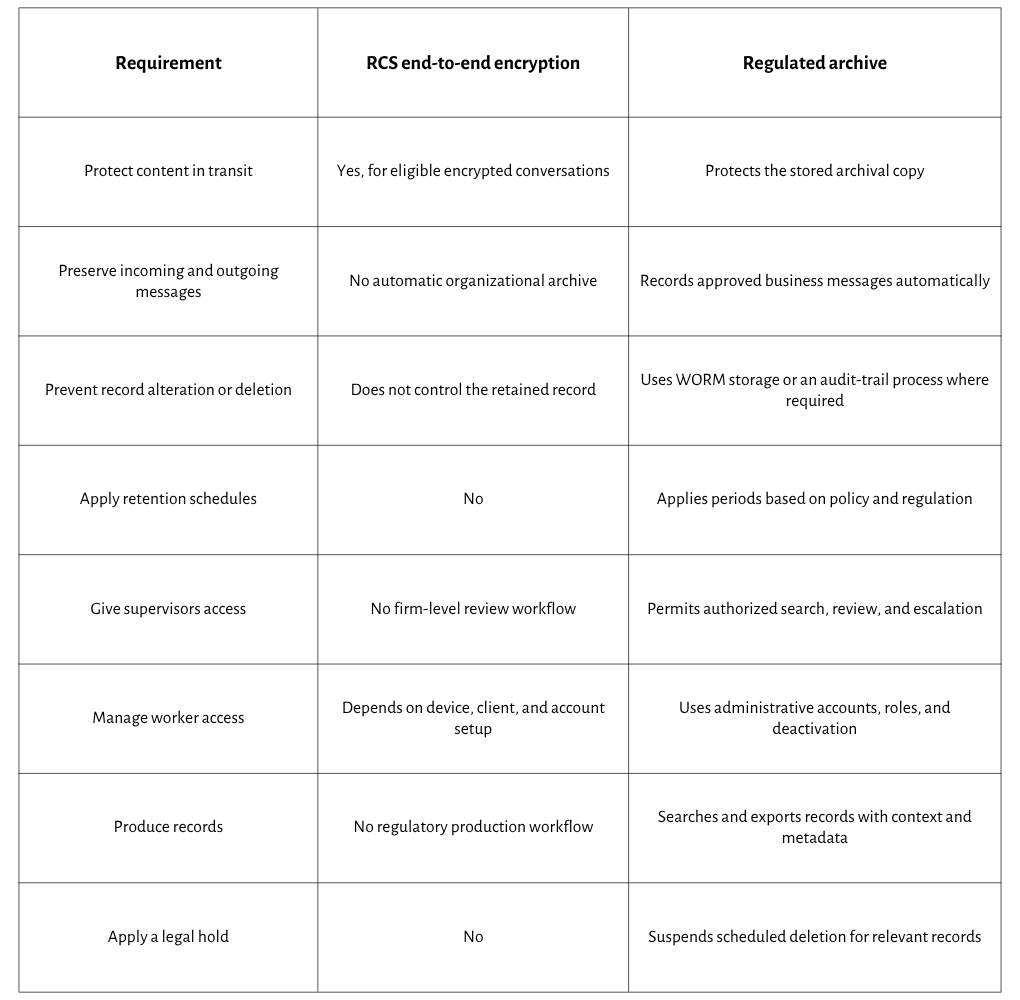
Neither control replaces the other. Encryption protects confidentiality. Archiving protects the availability, integrity, supervision, and production of records.
Why regulated sectors need both controls
Regulated sectors require both controls because of the following:
Financial services and insurance
Securities rules-based retention on the content and purpose of a communication, not on its encryption status.
A text about a recommendation, order, complaint, transaction, or customer account may be required to be recorded.
The SEC has repeatedly brought cases involving business messages sent through personal text and chat apps.
For example, an August 2024 SEC action involved 26 firms and more than $390 million in combined penalties after investigations found longstanding use of unapproved communication methods.
RCS encryption does not change the record’s business purpose. If the firm cannot preserve and supervise it, the message remains a recordkeeping problem.
Healthcare
Healthcare organizations need secure transmission, appropriate access, a BAA when a messaging vendor acts as a business associate, and documented security procedures.
However, encryption alone does not provide user administration, incident review, patient verification, or clinical documentation.
Care decisions, medication changes, and follow-up instructions may also belong in the EHR even when an encrypted message archive exists. The archive records the conversation; the EHR remains the designated clinical record.
Legal services
Law offices must protect confidential client communications and comply with discovery, preservation, and litigation hold obligations.
An encrypted RCS conversation can protect confidentiality during transit yet leave the firm unable to retrieve a complete thread after a lawyer deletes it or leaves the firm.
Therefore, legal communication requires a firm-controlled number, access rules, retention schedules, searchable archives, and call-recording procedures that account for federal and state consent laws.
How iPlum adds retention and supervision to secure mobile communication
RCS can improve the security of eligible mobile conversations.
However, regulated organizations need a business communication system designed around organizational ownership and record preservation.
iPlum's financial compliance line adds a dedicated business number to an existing smartphone.
That way, workers can use the iPlum line for client calls and texts, separating regulated communication from personal RCS, SMS, and phone history.
Here’s how iPlum allows you to do:
Archive business texts in WORM storage
iPlum automatically archives incoming and outgoing texts sent through the approved business line. The Enterprise archive uses non-rewriteable, non-erasable WORM storage and maintains an audit trail.
As a result, users cannot treat the business record like a disposable thread on a personal device. Authorized compliance personnel can search and export archived communications for review, examination, complaint, and investigation purposes.
iPlum offers six-year and ten-year retention options for financial communication. Administrators can select a period based on the organization's record categories, governing rules, and written policies.
Give compliance personnel administrative access
The business account console allows authorized administrators to create subaccounts, manage users, apply password policies, review logs, and deactivate access.
A departing worker does not take the business number or the message history.
Those controls also make supervision possible. Reviewers can examine firm communication from the administrative environment rather than collecting screenshots or requesting exports from personal phones.
Record regulated calls as well as texts
Text retention solves only part of mobile communication compliance. iPlum Enterprise can automatically record incoming and outgoing calls. A customizable announcement can notify participants that the recording is active.
The iPlum legal call recording also provides searchable call logs and downloadable recordings. Organizations should review applicable consent laws before recording and configure the announcement accordingly.
Combine security with record governance
iPlum encrypts data at rest and during transmission. It also adds the retention, administrative, and archival controls that ordinary RCS encryption does not create.
The Enterprise phone plan starts at $25.99 per user per month when billed annually and includes call recording, plus 10 years of call and text archiving.
No communication service completes compliance alone.
The organization still needs channel policies, role assignments, supervisory procedures, training, retention schedules, legal holds, and periodic review. iPlum gives those policies a controlled business line and a preserved communication record.
Frequently asked questions
Does RCS Universal Profile 3.0 encrypt every RCS message?
No. Encryption depends on compatible clients, endpoints, networks, and configuration. Organizations must also examine the scope of business messaging and the SMS or MMS fallback before approving RCS for regulated communication.
Can a firm archive an end-to-end encrypted message?
Yes. A business system can preserve an authorized copy at an endpoint or through an enterprise process. The archive still needs security, integrity, access, and retention controls.
Does encryption make a personal text channel compliant?
No. Encryption protects confidentiality. A regulated organization may still need approved-channel rules, automatic archiving, supervision, administrative access, retention schedules, audit records, and production capabilities.
How long must regulated messages be retained?
The period depends on the sector, record type, governing rule, and legal holds. Organizations should classify communications and document periods rather than apply one period universally.
What is WORM storage?
WORM means write once, read many. It preserves records in a non-rewriteable, non-erasable format, protecting stored communications from alteration or deletion during the required retention period.
Secure messaging needs a compliant record behind it
RCS Universal Profile 3.0 improves interoperable mobile encryption.
Yet confidentiality addresses only one part of regulated communication.
Organizations must also own the business channel, automatically archive messages, preserve record integrity, monitor activity, administer users, apply retention schedules, and produce responsive records.
iPlum brings those controls to mobile calls and texts through a dedicated business number, WORM archiving, administrative access, bidirectional call recording, audit logs, and long-term retention.
As a result, regulated organizations can protect sensitive communication and preserve the business record needed for examinations, complaints, investigations, and legal proceedings.

