


%20(1).avif)
.avif)

Financial advisors now communicate with clients through business text, email, social media, chat, video, mobile apps, and AI tools.
However, each channel works differently. A review process designed for email cannot adequately govern business texts, social posts, or video calls.
FINRA's Regulatory Oversight Report states that member firms should establish supervision and training rules for each approved channel and feature.
The report also points to problems such as incomplete message reviews, weak keyword searches, unreviewed non-English communication, and missing business texts.
As a result, approving an app is not enough. Firms must decide who can use each channel, archive required records, give reviewers access, train advisors, and document how the process works.
Below, you'll learn how to create a digital communication supervision plan and how iPlum can address the requirements for advisor calls and texts.
Table of Contents
1.What does FINRA's 2026 Regulatory Oversight Report say?
2. Why one generic digital communication policy is not enough
3. The eight parts of a channel-specific supervision plan
4. Why advisors need authorized business numbers
5. Why text archiving must connect to supervision
6. How iPlum puts mobile supervision controls into operation
8. Apply FINRA's 2026 findings to your communication channels
What does FINRA's 2026 Regulatory Oversight Report say?
FINRA's 2026 Communications with the Public report outlines effective practices for supervising digital communications.
It advises member firms to establish, maintain, and enforce reasonably designed procedures for digital channels.
The report addresses FINRA member firms and associated persons. Investment advisers outside FINRA should assess separate SEC and state obligations.
More specifically, FINRA tells firms to:
- Monitor new communication channels, apps, and features available to associated persons and customers.
- Define permitted and prohibited channels, tools, and features.
- Block prohibited options that prevent compliance with supervision or recordkeeping rules.
- Tailor supervisory reviews to each digital channel, tool, or feature.
- Develop written supervisory procedures for live streams, scripted video, and video blogs.
- Require training before an associated person receives access to an approved channel.
- Apply disciplinary measures when registered representatives violate the policy.
- Supervise and retain customer communications created through generative AI and chatbots.
The report does not require a separate document per channel. One written supervisory procedure can address several channels, but each needs suitable controls.
FINRA Rule 2210 sets content standards for correspondence, retail communications, and institutional communications. Rule 3110 requires a supervisory system and written procedures. Rules 4511 and 2210(b)(4), along with Exchange Act Rules 17a-3 and 17a-4, govern required records.
Consequently, the firm must connect content review, supervision, and record preservation. Approving a channel but failing to archive or review its messages leaves the framework incomplete.
Why one generic digital communication policy is not enough
Digital channels differ in their audiences, formats, editing functions, visibility, and storage. A review designed for a public social post will not address a private client text or live stream.
Channel procedures should define permitted users and content, approval rules, retention, reviewers, and consequences for violations.
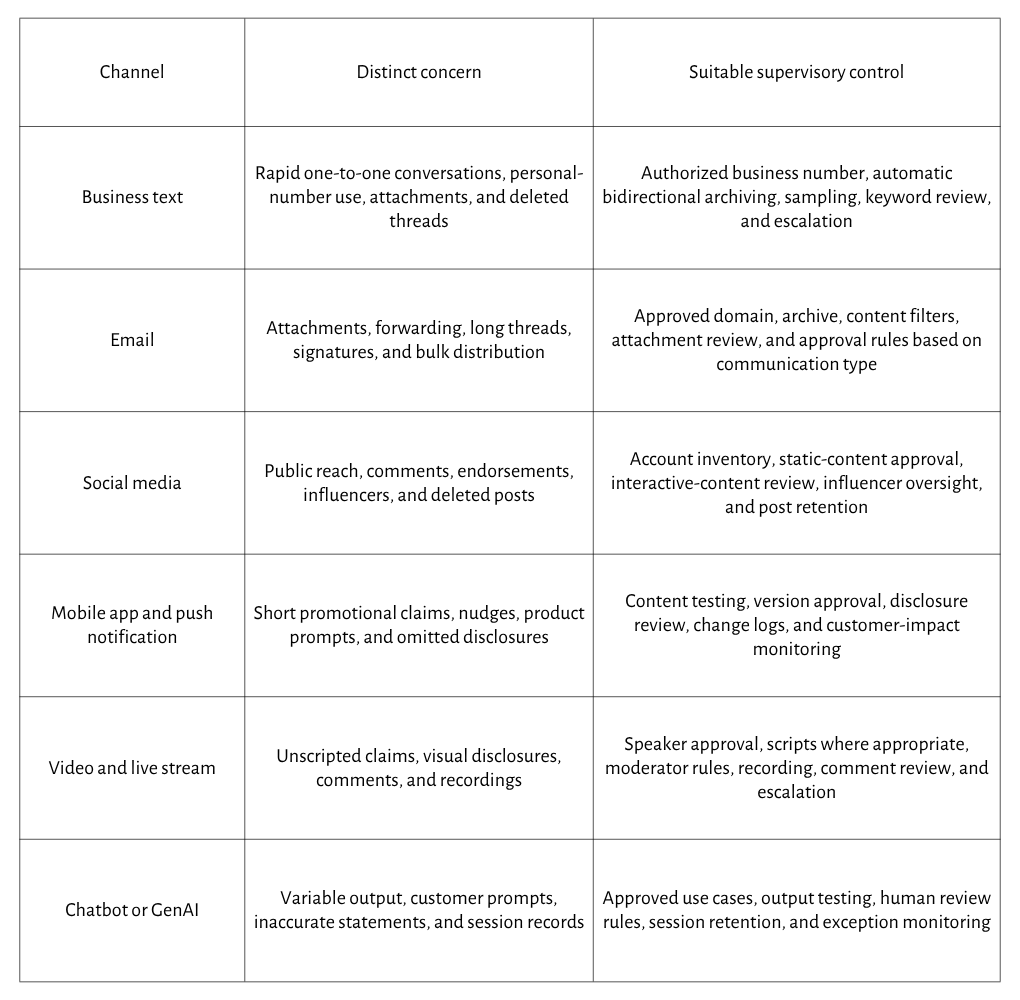
One governance framework can contain distinct controls for every communication method.
The eight parts of a channel-specific supervision plan
FINRA's report gives firms a useful framework for revising digital communication procedures. The plan should connect policy, technology, training, supervision, and testing.
1. Inventory every channel, tool, and feature
Start with approved systems, then identify channels used outside the list.
Include business text, personal SMS, social messages, collaboration chat, email, mobile-app notices, video, live streams, chatbots, and AI tools.
Record the business purpose, users, audience, data location, archive, reviewer, and vendor. Examine disappearing messages, editing, forwarding, group chat, attachments, and fallback.
An inventory should also identify accounts used by contractors, part-time compliance personnel, branch offices, and marketing vendors.
FINRA's books-and-records findings specifically mention failures involving third-party email, part-time CCOs, and outside vendors.
2. Define permitted and prohibited use
Name the approved channels and state what each channel may carry.
For example, a firm may approve business texting for appointment coordination and client service but prohibit trade instructions, performance guarantees, account credentials, or unapproved attachments.
Also, define prohibited channels. Personal numbers, disappearing-message apps, private social accounts, and unarchived chat tools can place business communication outside firm supervision.
List each approved number, app, account type, and permitted feature.
In addition, explain how workers should respond when customers initiate contact through an unapproved channel.
3. Assign authorized business identities
A policy becomes difficult to enforce when advisors use personal numbers for client texts.
The firm cannot readily distinguish business messages from private conversations, preserve the full thread, or transfer the number after an advisor leaves.
An authorized business number gives each advisor a firm-approved identity under business account administration, even on an existing smartphone.
Administrators should be able to activate, reassign, suspend, or remove access. The system should also display the business caller ID and route voicemail into the approved environment.
4. Archive messages automatically
FINRA's 2026 Books and Records report identifies failures to retain, archive, and review non-email communication conducted through approved channels. It also cites failures involving business text messages.
Therefore, approval alone is not enough.
The archive should automatically preserve incoming and outgoing messages, along with dates, times, participants, directions, and attachments.
Screenshots, advisor forwarding, and occasional exports can omit messages or metadata. A regulated archive should operate within the approved channel.
Record format also deserves attention. Exchange Act Rule 17a-4(f) permits broker-dealers to use non-rewriteable, non-erasable storage, commonly called WORM, or the rule's audit-trail alternative.
The selected system must preserve record integrity for the applicable period.
5. Design a review method for each channel
Define which content receives pre-use approval, post-use review, automated screening, targeted review, or sampling. The method can change by channel, audience, product, and prior conduct.
FINRA found inadequate samples, weak keyword searches, and missing reviews of non-English communication. Accordingly, firms should document sample size, selection method, search terms, languages, review frequency, escalation rules, and reviewer qualifications.
Keyword lists should reflect the firm's business, products, and customer conversations. Relevant terms can involve guarantees, performance, complaints, losses, confidential information, or unapproved channels.
6. Train users before granting access
FINRA lists mandatory training before access to an approved digital channel as an effective practice. Generic annual training cannot explain every feature or scenario.
Text-message training should address personal-number use, recipient verification, attachments, trade requests, complaints, message deletion, and movement from an unapproved thread.
Social-media training should address static posts, comments, endorsements, personal accounts, and influencer content.
Video and chatbot users need different instructions. Training should also explain how the firm monitors the channel, which records it retains, and what disciplinary action can follow a violation.
7. Establish administrative oversight and discipline
Compliance personnel need access to user accounts, archives, logs, settings, and review records. Individual user accounts allow the firm to attribute actions and apply role-based permissions.
The plan should define who can create accounts, change settings, export records, assign reviewers, and deactivate users. It should also address departures, role changes, lost phones, branch transfers, and vendor access.
FINRA's report describes temporary suspension or permanent blocking from certain channels after violations. A firm can also require added training before restoring access. Written disciplinary options give managers a consistent response to channel misuse.
8. Test controls and monitor channel changes
Digital tools change after approval.
A vendor may add disappearing messages, AI drafting, file sharing, live audio, or a new fallback method. Therefore, firms should review feature releases and reassess the channel when functionality changes.
Test sample messages, attachments, replies, and group texts, then retrieve them by user and date. Also test user removal, permissions, search, export, and reviewer access.
FINRA suggests simulating a regulatory examination by requesting records from a vendor. Document the test date, expected result, exceptions, remediation, and completion evidence.
Why advisors need authorized business numbers
Off-channel communication begins when an advisor discusses firm business through a channel the firm has not authorized and does not routinely archive, supervise, or retain.
A personal phone number can create that problem even if the firm permits the device itself.
That said, bring-your-own-device and bring-your-own-channel are not the same policy.
A firm can allow an existing smartphone yet require advisors to place every business call and text through a managed business line.
The business number should link the advisor identity, archive, user account, and administrative console. The firm then retains control after role changes or departure.
Why text archiving must connect to supervision
An archive is not merely a backup. It should preserve required records in a format the firm can search, review, and produce.
FINRA Regulatory Notice 17-18 states that a firm planning to permit text or chat communications about its business must first confirm that it can retain the records.
The content determines whether the firm must retain the communication.
As a result, a firm should not archive only selected advisors, message types, or customer conversations. The approved process should preserve the complete business thread and give reviewers access under written procedures.
Retention periods depend on the record and governing rule. FINRA Rule 4511 applies a six-year default to FINRA records that do not have another specified period. Firms must classify records rather than apply one period to every message.
How iPlum puts mobile supervision controls into operation
A channel-specific policy needs a mobile system that the firm can authorize, administer, archive, and review.
iPlum's financial mobile compliance line creates a dedicated business line on an advisor's existing smartphone, which allows you to:
Assign authorized business numbers
Each advisor can use an iPlum number for business calls, texts, and voicemail.
The personal number remains separate. Therefore, the firm can approve a defined channel rather than attempting to supervise messages mixed into a private phone account.
The business account console lets administrators create subaccounts, assign numbers, manage users, apply password policies, and review audit logs.
When an advisor changes roles or leaves, the firm can revoke access while retaining the number and records.
Archive and review business texts
iPlum text message archiving for financial services automatically preserves incoming and outgoing texts from the business line.
Its Enterprise plan offers non-rewriteable, non-erasable WORM storage and maintains an audit trail.
Authorized compliance personnel can search and export communication for supervisory reviews, complaints, examinations, and investigations. Six-year and ten-year retention options allow the firm to apply its documented schedule to mobile records.
Extend the policy to voice communication
iPlum Enterprise can automatically record incoming and outgoing calls.
A customizable announcement can notify participants that the recording is active. Firms should review federal and state consent laws before enabling recording and document the approved configuration.
Call and text logs also provide administrators with activity records for the business line. Consequently, the firm can examine mobile communication through the approved account rather than requesting screenshots or device histories from advisors.
Protect the communication environment
iPlum encrypts data at rest and during transmission. The service also separates business communication from native personal calling and texting on the device.
The iPlum Enterprise plan starts at $25.99 per user monthly when billed annually. It provides call recording, 10 years of recordings, and text archiving.
iPlum does not replace written supervisory procedures, training, review criteria, record classification, or disciplinary rules.
However, it gives the firm an authorized mobile channel with business ownership, administrative access, archiving, and records for review.
Frequently asked questions
Does FINRA require a separate written plan for every digital channel?
FINRA does not name a separate-document requirement. Its 2026 report says firms should tailor supervisory reviews, controls, and training to every approved digital channel, tool, and feature.
Can financial advisors text clients under FINRA rules?
Yes, if the firm authorizes the channel and meets applicable content, supervision, recordkeeping, retention, and production duties. Personal unarchived texting can create off-channel communication.
Does an encrypted messaging app satisfy FINRA recordkeeping?
No. Encryption protects message content, but it does not automatically archive, preserve, supervise, search for, or produce business communications in accordance with the firm's written procedures.
How long must a firm retain advisor text messages?
The period depends on the communication and the applicable rule. FINRA Rule 4511 uses a six-year default only when no other FINRA or Exchange Act period applies.
What should channel-specific training address?
Training should address approved uses, prohibited content, personal accounts, record retention, channel features, customer complaints, security, escalation, supervisory review, and disciplinary consequences before access is granted.
Apply FINRA's 2026 findings to your communication channels
FINRA's 2026 report says firms must supervise every approved communication channel based on its features and purpose.
Business texts, social media posts, video calls, mobile app messages, and AI chats cannot use the same review process.
First, list all channels advisors can use. Next, explain what advisors can and cannot do on each channel. Assign approved business numbers and accounts. Then, archive the required records and choose who will review them.
Firms should also train advisors before granting access. Administrators must manage user permissions and regularly test the supervision process.
For advisor calls and texts, iPlum provides a business-owned mobile number. It also offers WORM archiving, audit logs, user administration, and long-term record retention.
Sign up for iPlum to get started

