


%20(1).avif)
.avif)
OhMD positions itself as a patient communication platform built for healthcare practices.
And, in all fairness, it looks like a reasonable pick.
It offers features such as two-way SMS, video calling, voicemail transcription, appointment scheduling, and EHR integration under the hood.
But that script flips once you look at the OhMD pricing plans.
A solo physician or small clinic can expect to pay at least $300 a month just to get started. AI features? Well, those are only available in the $500-per-month Automate plan. What about the calling costs? Those are billed separately on top of whichever plan you choose.
For small practices already watching every dollar, that adds up fast.
Sure, OhMD may be built for busy healthcare providers. However, the price points to something different in terms of who it actually fits.
Healthcare teams with tighter budgets need HIPAA-compliant messaging without the steep monthly commitment.
This article gives you a detailed breakdown of OhMD's pricing, what each plan actually gets you, where the costs pile up, and why iPlum is worth a serious look as a more affordable alternative.
Also read: iPlum vs. OhMD—Which is the Best for Patient Communication?
Table of Contents
1. OhMD pricing plans: what do you get at each tier?
2. Where OhMD's pricing starts to get uncomfortable
3. OhMD cost: a look at value vs. cost
4. iPlum: HIPAA compliance without the steep price tag
5. OhMD pricing vs. iPlum: side-by-side cost comparison
OhMD pricing plans: what do you get at each tier?
OhMD offers three distinct plans: Communicate, Automate, and Enterprise.
Here is what each one gets you.
The Communicate plan — $300 per month
The Communicate plan is OhMD's basic offering. At $300 a month, you get:
- Two-way SMS with patients
- Text-enabled landline, voice, and video calling
- Voicemail transcription
- Call handoff to text
- Website chat and team messaging
- Standard automated workflows
- Broadcast messages
- Multi-factor authentication (MFA) and a Business Associate Agreement (BAA)
For $300 a month, you get a solid set of essential features for patient texting and basic patient communication. However, there is no AI, automatic message routing, or EHR integration at this tier.
The Automate plan — $500 per month
The Automate plan builds on everything in Communicate and adds:
- Patient call automation via Nia AI voice and text
- Automatic message routing
- Customized automated workflows
- Broadcast voice calling
- Appointment scheduling and EHR integration
- Early access to new features
- Premium support
Note that calling usage is billed separately at this tier. So the $500 per month figure is a starting point — actual costs run higher depending on call volume.
The Enterprise plan — custom pricing
The Enterprise plan is built for larger organizations. It packs everything from both lower tiers and adds:
- Custom pricing with volume discounts
- SSO and identity management
- Multi-location/multi-tenant capabilities
- Reporting and analytics
- API and integration extensions
- Annual billing incentive
The pricing for the OhMD Enterprise plan isn't publicly available. You have to contact OhMD directly for the costs. Minimums apply, and calling usage is billed separately here as well.
Where OhMD's pricing starts to get uncomfortable
Sure, the features on OhMD's pricing page are impressive. However, a closer look at the OhMD cost structure reveals a few points worth noting before you commit.
$300 per month is a flat fee — not a per-user price
Most patient communication software charges per user.
OhMD pricing, however, works differently. The $300 per month Communicate plan is a flat practice fee. For a larger practice, that might be reasonable. But for a solo practitioner or a two-person clinic, you are paying $300 a month for a set of features you may never fully use.
AI features cost an extra $200 per month
The Nia AI voice and text automation — arguably the most compelling part of what OhMD offers — costs $500 per month on the Automate plan.
If patient call automation and customized automated workflows are the reason you are considering OhMD, the Communicate plan at $300 per month does not include those features. You have to spend $500 per month to access those advanced capabilities.
Calling usage is billed separately
On both the Automate and Enterprise plans, calling usage is billed separately.
The trickiest part is that OhMD does not publish the rates.
For any medical practice fielding a high call volume, this can be an impactful variable. It means your monthly bill could climb well above the base price of the paid plans, depending on how many routine calls your practice handles.
Enterprise pricing offers zero transparency
The Enterprise plan lists custom pricing with no published starting point.
Therefore, you cannot budget for it, compare it, or evaluate it without speaking with OhMD's sales team. For healthcare practices seeking to make informed decisions, the lack of transparency can be an obstacle.
The fine print also notes that minimums apply, meaning even if you're running a small organization, you may still be locked into spending you didn't anticipate.
OhMD cost: a look at value vs. cost
To be fair, OhMD is not a bad product.
The OhMD app packs a good, comprehensive suite of patient communication tools. AI voice automation, EHR integration, broadcast messaging, appointment reminders, and video visit capabilities are all helpful features that solve real problems for busy healthcare providers.
The question is not whether OhMD works. The question is whether the price matches what most medical practices actually need.
Where OhMD pricing makes sense
OhMD is a reasonable fit for mid-to-large practices with predictable budgets, dedicated administrative staff, and enough patient outreach volume to justify the cost.
However, if your practice handles hundreds of patient calls daily and needs Nia AI voice to manage that volume, the $ 500-per-month Automate plan becomes justified.
In addition, large organizations that need multi-location coverage, SSO, and deep EHR integration get value from the Enterprise plan, provided they can navigate the opaque pricing process.
Where the value gets harder to defend
The Communicate plan at $300 per month includes two-way patient texting, voicemail transcription, call handoffs to text, and standard automated workflows.
Those are useful tools. However, at $300 a month flat, a solo provider or small clinic is paying a premium for a platform built around a scale they do not operate at.
The Automate plan's value depends heavily on how much your practice leans on patient call automation.
If you are not routing large call volumes through Nia AI, you are paying $500 per month for features you're not using.
Add unpublished calling usage fees on top, and the OhMD cost for an average small practice can easily exceed the headline prices for a feature set that may be more than that practice actually needs.
Patient engagement tools are only worth the price if your practice can extract enough value from them to justify the spend. And, for a significant portion of small practices, the math simply does not work out in OhMD's favor.
iPlum: HIPAA compliance without the steep price tag
iPlum is a HIPAA-compliant messaging platform built for healthcare providers who need a dedicated business number, secure, encrypted texting, and a Business Associate Agreement (BAA) without paying hundreds of dollars a month to get there.
The platform offers a per-user pricing model, which makes it the best OhMD alternative for solo practitioners and small clinics.
Here's what iPlum Professional plan (an OhMD base tier equivalent) gets you:
First, the plan costs 14.99 per user per month. For a healthcare practice that needs a reliable HIPAA-compliant texting solution, that price includes:
- Secure, encrypted texting via mobile app or app-less online access
- Voicemail transcription
- Group text and broadcast text
- A dedicated US or Canada number for patient communication
- Phone tree, auto-attendant, and extensions
- Business Associate Agreement (BAA)
- Text archiving for one year
- Schedule text and text templates
- Web calling and texting
- Share number across users
The Professional plan also includes a free iPlum account for your client. That way, your patients can receive and exchange secure, encrypted texting on their end at no extra cost.
True HIPAA compliance
HIPAA-compliant messaging is not an add-on or an upgrade with iPlum.
The Professional plan includes a signed BAA and encrypted messaging as standard. With iPlum, a healthcare provider does not need to reach a spending threshold or negotiate a contract to get compliant communication tools.
iPlum is built in line with how small practices operate
iPlum runs on iOS, Android, and the web.
As a result, healthcare providers can use it in their existing devices without new hardware or a complicated setup. In addition, the phone tree, auto-text reply, business hours configuration, and voicemail transcription are included in the $14.99 monthly rate.
And for practices that need call recording, text compliance archiving for up to 10 years, and a recording consent announcement, iPlum's Enterprise plan covers all that for $25.99 per user per month. Still, that's a fraction of what OhMD charges for its entry-level Communicate plan.
Sure, iPlum may not deliver AI voice automation or deep EHR integration. However, for healthcare practices whose primary need is dependable, HIPAA-compliant SMS and calling at a price that makes sense, iPlum covers that ground without the steep monthly commitment.
OhMD pricing vs. iPlum: side-by-side cost comparison
When it comes to the OhMD vs iPlum pricing all you have to do is look at the numbers. Here is how OhMD pricing vs. iPlum plays out across three common practice sizes.
Solo practitioner (1 provider)
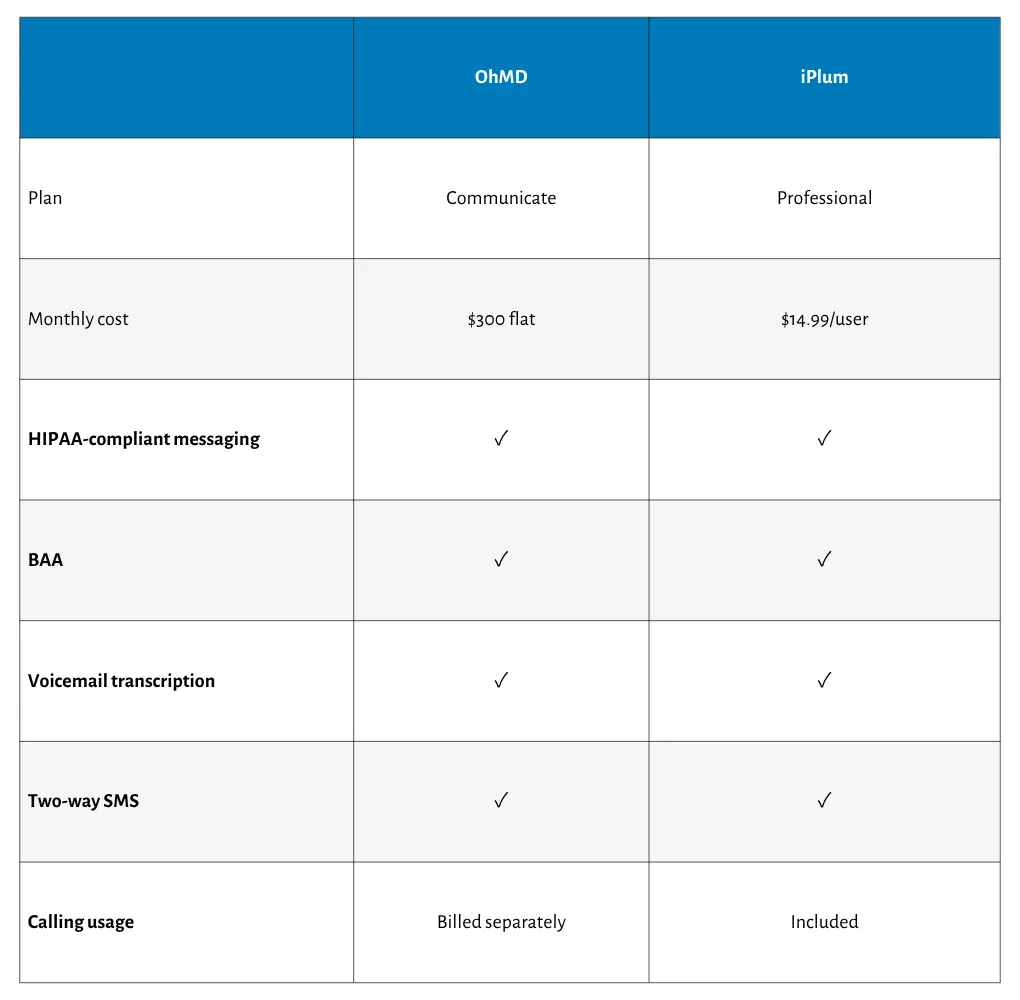
A solo provider pays $300 per month with OhMD.
The same provider pays $14.99 per month with iPlum. That is a difference of $285 every month or $3,420 per year for a comparable set of HIPAA-compliant texting and calling features.
Small practice (3 providers)
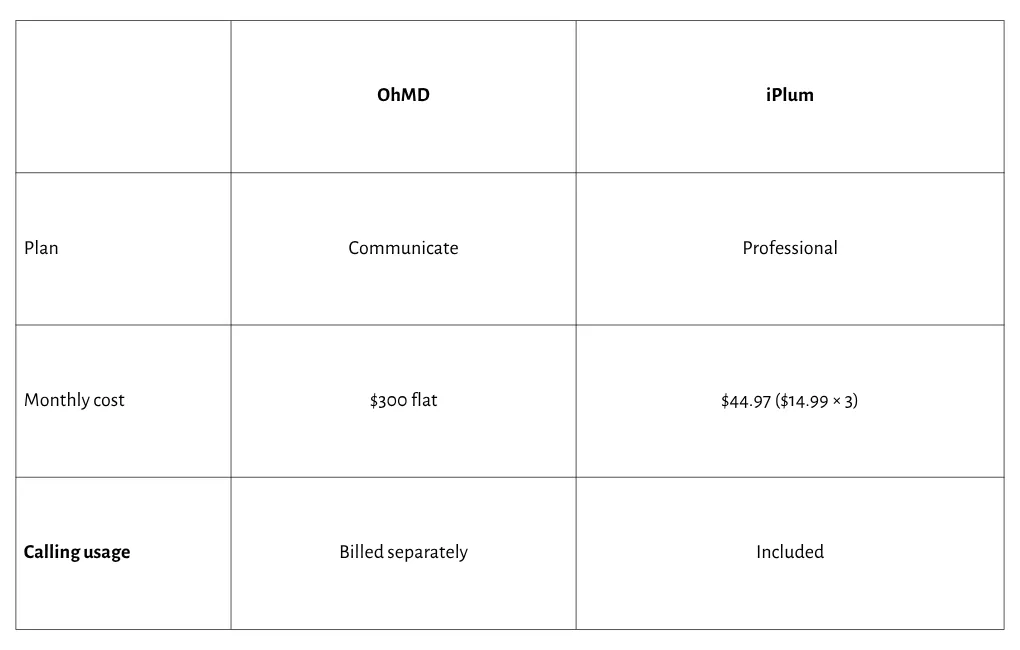
OhMD charges a flat $300 regardless of how many users you have.
iPlum, in comparison, charges $14.99 per user, so three providers pay $44.97 per month. That is still a $255 monthly difference or $3,060 per year.
Small practice needing AI features (3 providers)
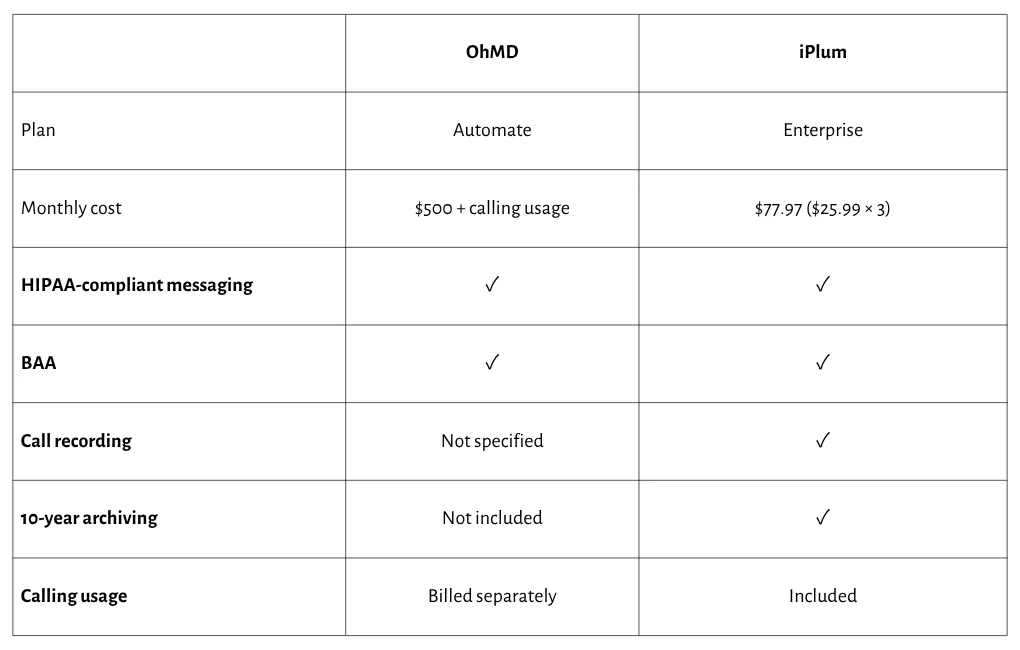
If a small practice needs patient call automation and upgrades to OhMD's Automate plan, the base cost jumps to $500 per month before calling fees.
iPlum's Enterprise plan for 3 users costs $77.97per month, with call recording and 10-year archiving included.
Sure OhMD's Automate plan offers Nia AI voice and EHR integration. However, for practices that do not need those specific features, the OhMD cost is significantly harder to justify against what iPlum offers at a fraction of the price.
The bottom line
OhMD is a solid patient communication platform. And for large healthcare organizations with high call volume, complex EHR integration needs, and the budget to match, it can be a good investment.
But for solo practitioners and small practices, the OhMD pricing structure creates a problem.
First, a $ 300-per-month flat fee is a steep entry point. In addition, AI voice features cost an additional $200 per month. Meanwhile, calling usage gets billed separately at rates that OhMD does not even publish. Besides, the Enterprise plan requires a sales conversation before you can even evaluate the cost.
That is a lot of financial uncertainty for a medical practice trying to make a straightforward, informed decision about patient communication software.
iPlum is different.
At $14.99 per user per month, the Professional plan gives healthcare providers a dedicated business number, secure, encrypted texting, voicemail transcription, HIPAA-compliant messaging, and a signed BAA. iPlum offers pricing that scales with the size of your practice, not against it.
And for practices that need call recording and long-term text archiving, the iPlum Enterprise plan covers them for $25.99 per user per month. With iPlum, there’s no opaque pricing, separate calling bills, or spending minimums buried in the fine print.
HIPAA-compliant texting and reliable patient communication should not require a $300 monthly commitment before you can even get started.
iPlum proves that a healthcare practice can get the communication tools it needs at a price that aligns with its needs. And you don’t have to leave a hole in your budget.
Want in? Click the link below to get started.
Disclaimer: This article is intended for general informational purposes and may not reflect the most current features or capabilities of the products or companies mentioned. For the most accurate and up-to-date information, please refer to the official sources of each company.

