
How Much Does a Virtual Receptionist Cost? [And a More Affordable Option]

You don't want missed calls at your business.
Because when a potential customer calls your office, nobody answers, and they move on to the next business on their list. And that's lost revenue, which can add up fast. Virtual receptionist services allow you to address that inconvenience. However, the cost can surprise you.
This article breaks down exactly how virtual receptionist pricing works, what you can expect to pay, and the hidden costs most providers bury in the fine print.
We’ll also tell you how iPlum's phone tree gives small businesses a cost-effective option worth serious consideration.
Table of Contents
1. Virtual receptionist: a quick overview
2. How does virtual receptionist pricing work?
3. What virtual receptionist services typically cost
4. The hidden costs most providers don't mention upfront
5. What you pay vs. what you actually get
6. iPlum phone tree — a leaner, more affordable alternative
7. Who does the iPlum virtual receptionist work best for
8. Does a virtual receptionist justify the cost?
Virtual receptionist: a quick overview
A virtual receptionist answers incoming calls on behalf of your business.
Depending on the service, a live agent or an AI agent can greet callers, take messages, route callers to the right department, schedule appointments, answer questions, and handle after-hours coverage when your office is closed.
Some services use human receptionists exclusively. Others rely on AI receptionists. And then there are those providers who offer hybrid models that combine both. That said, the type of service you choose directly affects your monthly cost.
How does virtual receptionist pricing work?
Virtual receptionist pricing models fall into three main categories. And, understanding each one saves you from a billing shock at the end of the month.
Per-minute pricing
Per-minute pricing charges you for every minute a receptionist spends on your calls. Rates typically range from $1.50 to $3.50 per minute, depending on the provider and plan.
On the surface, per-minute billing looks affordable. However, the actual costs show up during busy periods. A high-volume month can turn a modest base rate into a bill three times what you expected. Chatty callers make it worse. One 20-minute call burns through a big chunk of your monthly call minutes.
There is another trap worth knowing.
Some providers bill in full-minute increments. A call that runs 3 minutes and 10 seconds gets billed as 4 full minutes. Per-minute billing in 30-second or full-minute increments can inflate your actual bill by 30 to 40 percent.
Per-call pricing
Per-call pricing charges a flat rate for each call the service answers, regardless of its duration. Rates generally start around $7 to $9.75 per call.
This model sounds predictable, but it punishes businesses with high call volume.
Twenty short two-minute calls cost the same as twenty complex fifteen-minute calls. Therefore, a busy month equals a painful bill.
Flat monthly fee
A flat monthly fee gives you a set price for a bundle of calls or minutes. Overage fees apply once you exceed the limit, but the base cost stays predictable.
AI receptionist services tend to use flat monthly pricing. Some offer unlimited calls at a fixed rate, eliminating overage risk entirely. For most small businesses, a flat monthly fee delivers the most predictable costs.
What virtual receptionist services typically cost
- Virtual receptionist pricing varies widely depending on service type and call volume. Here's a quick breakdown:
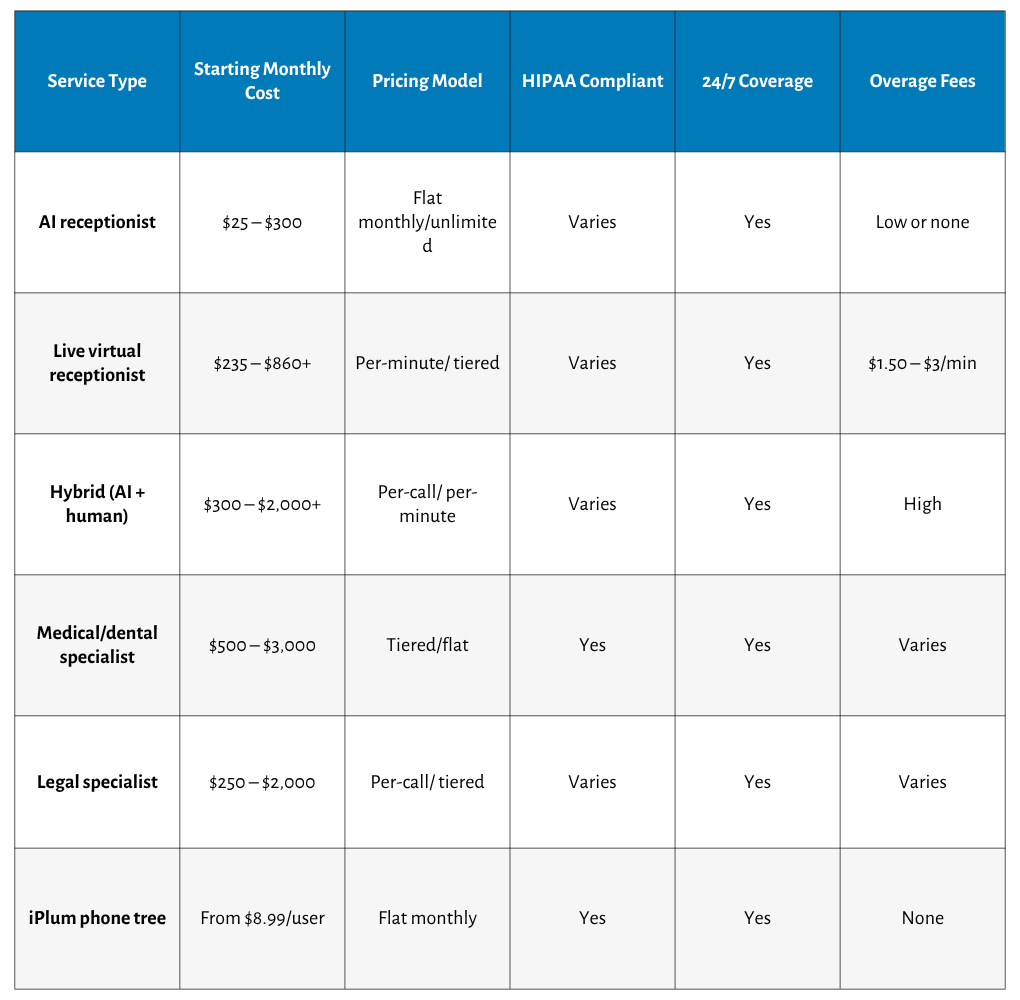
- AI receptionists sit at the lower end, with rates ranging from $25 to $300 per month. Some AI-powered plans offer unlimited calls at flat rates around $199 per month, with no per-minute charges or overage fees.
- Live virtual receptionists cost significantly more. Entry-level plans with limited minutes start around $235 per month for 50 receptionist minutes. As call volume grows, costs climb to $575 per month for 350 minutes or $720 per month for 500 minutes.
- Hybrid models that combine AI with human backup land somewhere in the middle, typically between $300 and $2,000 per month depending on call volume and complexity.
- Specialized services for industries like healthcare and legal cost more. Medical and dental practices that need HIPAA-compliant answering services typically budget between $500 and $3,000 per month. Legal intake services with conflict checks and CRM integrations can run $250 to $2,000 per month.
A full-time in-house receptionist costs even more.
Factor in salary, benefits, payroll taxes, and overhead, and a front desk hire runs $4,100 to $5,600 per month. Sure, virtual receptionist services can save money compared to that benchmark. However, the savings depend heavily on the plan you choose and the number of calls you receive.
Virtual receptionist pricing comparison table
The hidden costs most providers don't mention upfront
The advertised monthly rate is rarely the full story. Virtual receptionist pricing often hides additional charges that add 30 to 60 percent to your actual bill.
Setup fees
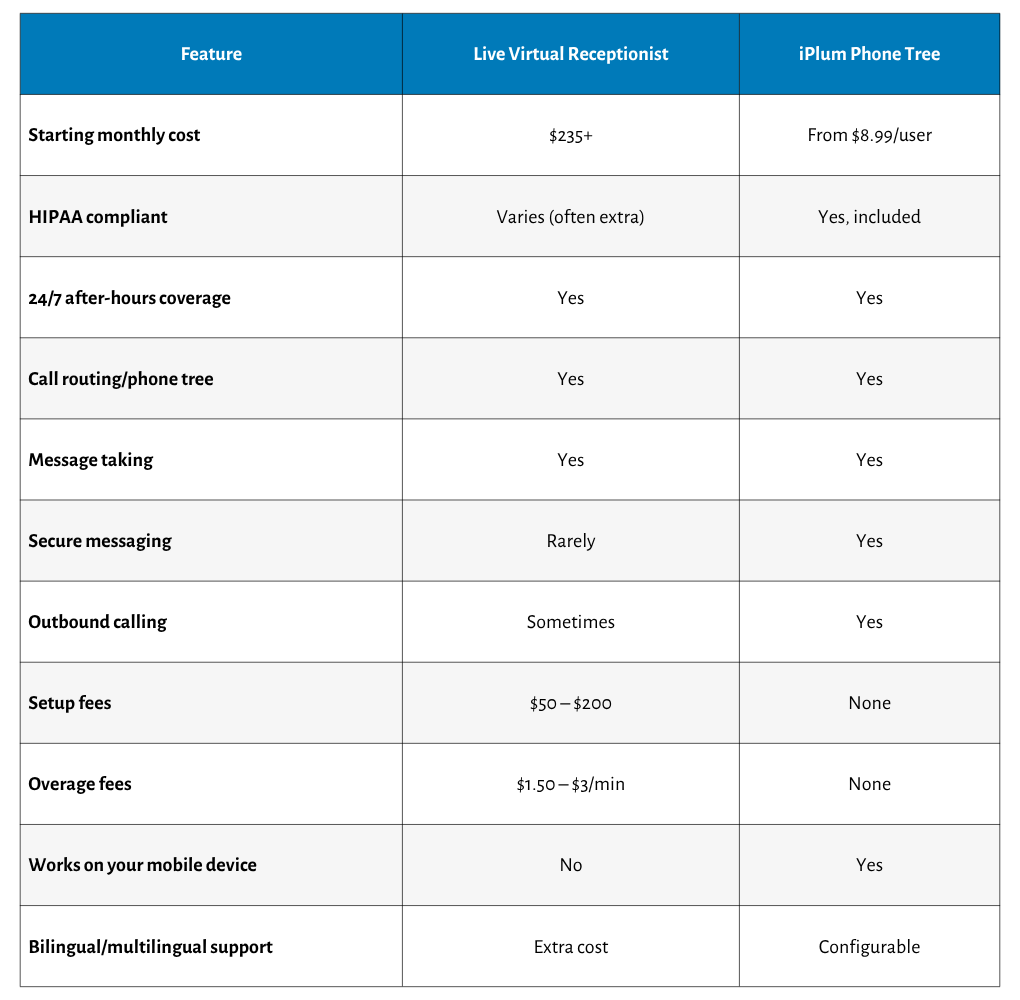
Many providers charge a one-time setup fee to configure your account. These fees range from $50 to $200 and sometimes higher for complex enterprise setups. Ask about this before signing anything.
Minute rounding
How a provider counts call time is critical. Per-second billing is rare but most favorable.
Thirty-second increment billing means a 31-second call costs you for 60 seconds. Full-minute increment billing means a 3-minute, 10-second call costs you 4 full minutes. That difference adds up significantly over a month with high call volume.
Add-on charges
Features you might assume come standard often carry extra costs.
For instance, bilingual support or multilingual support can add $50 per month or more. After-hours coverage sometimes appears as an add-on rather than a base feature.
CRM integrations, call recording, and outbound calling capabilities are often listed as separate line items on your invoice. Therefore, always ask for a complete fee breakdown before committing to any virtual receptionist plans.
What you pay vs. what you actually get
The sticker price of a virtual receptionist service tells you very little without context.
A $ 235-per-month plan that covers only 50 minutes of live agent time may not be enough for a busy practice. Exceed that limit, and overage fees of $1.50 to $3 per additional minute apply.
Per-minute pricing makes sense for businesses with very low call volume and short, predictable calls. A business receiving fewer than 20 calls per month with simple inquiries can manage costs under this model.
Per-call pricing makes sense when call complexity varies widely, and you want consistency regardless of call length.
Flat monthly fees make the most sense for businesses with moderate to high call volume. Predictable costs allow you to budget accurately without worrying about a spike during your busiest month.
Bundled plans that combine message taking, call transfers, and after-hours coverage into one flat rate offer the best overall value for most small businesses.
What most virtual receptionist services do not offer at an affordable price point is HIPAA compliance, a dedicated business number, secure messaging, and a phone tree — all bundled into a single low monthly cost.
That is where iPlum changes the math.
iPlum phone tree — a leaner, more affordable alternative
iPlum is a mobile-first phone system built for team management, security, and scale, targeting small businesses, solo practitioners, medical offices, and professional service providers.
Its phone tree feature automates call routing without requiring a live agent on the other end.
What the iPlum phone tree does
The iPlum phone tree greets incoming calls with a recorded or text-to-speech message, then automatically routes callers to the right extension.
As a result, callers hear a professional greeting and select from menu options to reach the right person or department.
The system answers calls around the clock, including after hours and weekends. That way, callers never reach a dead end. The phone tree routes to voicemail, sends automated text responses, or forwards to a live number, depending on how you configure it.
iPlum also handles call transfers, message taking, and secure messaging, all in full compliance with HIPAA. Healthcare providers can manage patient calls without worrying about data security.
In addition, the platform runs on your existing mobile device, so there is no desk phone or separate hardware to buy.
iPlum also offers dual call reliability. With this feature, calls route through your voice network for carrier-class reliability or through Wi-Fi, 3G, 4G, or LTE data. Your iPlum business number shows as the caller ID on both modes. Wherever you are, callers always reach a professional front desk experience.
What iPlum costs
iPlum plans start at $8.99 per user per month.
The platform offers transparent pricing with no setup fees and no overage charges for standard usage. HIPAA compliance, the phone tree, secure messaging, and call recording come included in the plan — not as paid add-ons.
For a solo practitioner or small clinic, iPlum costs a fraction of what live virtual receptionist services charge per month.
Who does the iPlum virtual receptionist work best for
iPlum works best for businesses that need professional call answering, HIPAA compliance, and reliable routing at a price that does not scale against them as their business grows.
Solo medical practitioners, small clinics, therapists, dentists, and specialist practices get HIPAA-compliant call management at a fraction of the cost of traditional answering services.
Small law firms, on the other hand, get a dedicated business number, call routing, and voicemail without paying legal-specialist answering service rates.
Also, independent consultants and home services providers get a professional front desk experience on their mobile phones without hiring in-house staff or paying for live-agent minutes they may not use.
Simply put, iPlum is for any business tired of missed calls but unwilling to pay $300 to $800 per month for a live virtual receptionist.
Does a virtual receptionist justify the cost?
Indeed, live virtual receptionist services deliver real value for businesses with complex intake needs, high-value calls, or industries that genuinely require a human touch on every single interaction.
If your average client is worth thousands of dollars and a missed call means lost revenue at that level, paying $400 to $800 per month for live answering services makes financial sense.
For most small businesses, solo practitioners, and growing practices, the math tells a different story.
Per-minute billing, overage fees, setup costs, and add-on charges push the real monthly cost of virtual receptionist services well above the advertised price.
iPlum offers professional call routing, after-hours coverage, HIPAA compliance, and secure messaging at a monthly cost hard to argue with. The phone tree operates 24/7, routes callers correctly, and presents a polished business image without the cost of a live agent answering every call.
So if your calls are routine, your volume is moderate, and your budget is tight, iPlum makes a robust, powerful alternative.
Sign up for iPlum below.