


%20(1).avif)
.avif)
Nearly 90% of consumers say they prefer text messages over phone calls when contacting a business.
The scenario is the same in medical setups.
Your patients want you to text them reminders, updates, and follow-ups instead of calling when they’re at work or busy. It is easier, faster, and more personal. However, the convenience comes with compliance risks.
Texting about appointments is one thing.
But once a text message includes health details, test results, or prescriptions, it’s a different ball game altogether. Text containing Protected Health Information (PHI) falls under strict privacy laws. And that’s where you should never go wrong as a healthcare provider.
The point is, there’s more to secure patient texting than using a messaging app. You want to make sure you’re using an app that encrypts data, verifies identity, and provides the required Business Associate Agreement (BAA) under HIPAA.
So before adopting any texting phone service for doctors, you need to understand what makes a message secure, what HIPAA allows, and how to use texting responsibly in your practice.
We’ll start by explaining what secure patient texting really is.
Table of Contents
1. What counts as secure patient texting?
2. What does HIPAA say about texting patients?
3. Can I use standard SMS to text patients?
4. What should I look for in a secure texting app for patients?
5. How to implement secure texting in your practice
6. Text patients safely with iPlum's HIPAA-compliant texting messaging solution
What counts as secure patient texting?
Secure patient texting involves encrypting messages, verifying user identity, and controlling access to patient data. It protects PHI during transmission and storage, ensuring no unauthorized person can read or forward sensitive details.
In fact, that’s the primary reason healthcare providers use HIPAA-compliant texting phone systems. These apply end-to-end encryption, keep records on secure servers, and assign each user a verified login. With such a structure, practices can manage who sends, reads, or deletes messages, creating accountability at each of these steps.
What does HIPAA say about texting patients?
HIPAA has strict privacy and security standards for all digital communication in healthcare. It seeks to ensure that sensitive patient data remains protected, whether stored on an electronic health record system or exchanged through a secure text.
Texting patient information is allowed under HIPAA, only when proper safeguards are in place.
These include encryption during transmission, verified user identities, and audit logs that record message activity. More on that in a short while.
Can I use standard SMS to text patients?
No, you cannot use standard SMS to text your patients. And there are valid reasons this is the case, for sensitive patient information, including:
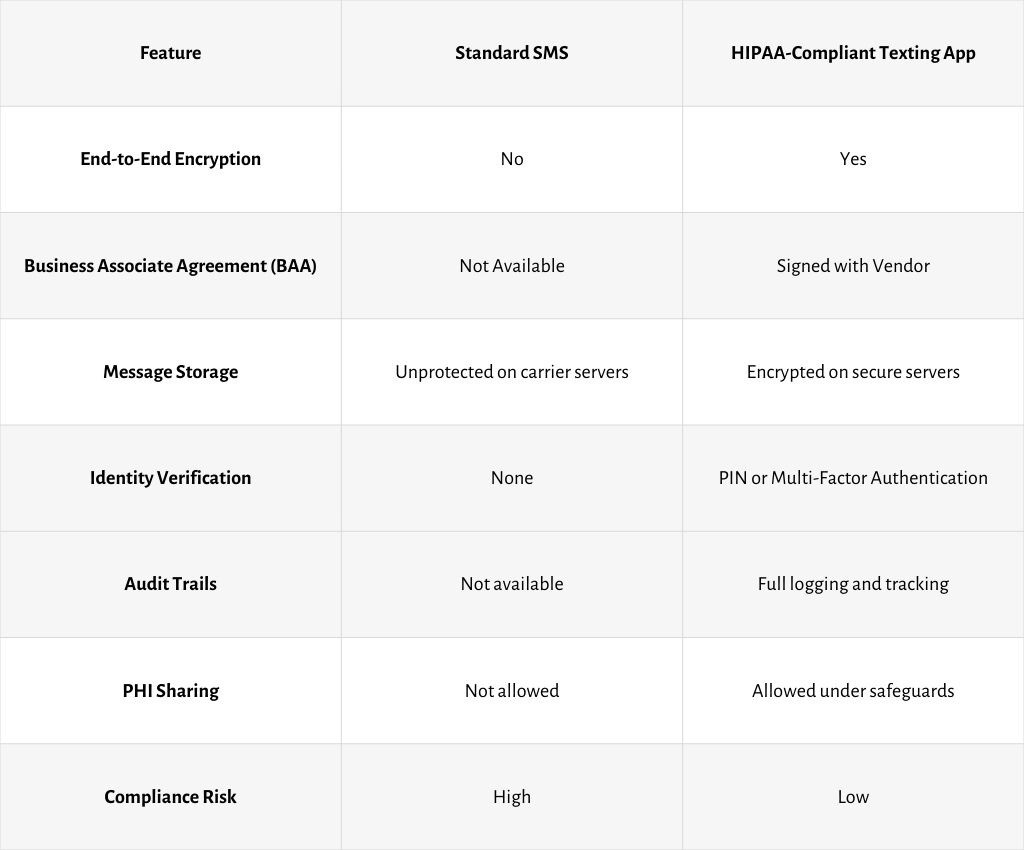
1. Standard SMS isn’t encrypted
Text messages travel through carriers in plain text. They aren’t protected by end-to-end encryption, meaning third parties can intercept them.
So, anyone with access to the network or device could read those messages. As a result, standard SMS is unsafe for sharing details tied to patient communication.
2. The shared devices scenario
Texts often remain unprotected on phones or carrier servers. In shared environments such as a family iPhone or an office tablet, other users can easily access them. The gap disqualifies SMS from being HIPAA-compliant messaging, since patient data must remain private and auditable.
3. “Secure” phones still break compliance
Even high-security smartphones fail compliance if they send messages through regular mobile carriers. Furthermore, encryption built into the device does not extend to SMS delivery.
Only HIPAA-compliant texting platforms built for health systems can ensure protection throughout the transmission chain.
4. There is a limit to what you can and can’t send
Sure, you can send general appointment reminders or front-desk announcements using standard SMS, as they don’t expose PHI. However, you can’t share lab results, medication details, diagnoses, or billing records through regular SMS.
Those require HIPAA-compliant text messaging tools that encrypt and store messages safely.
5. You could be setting yourself up for fines and penalties
Violations of HIPAA regulations can lead to steep fines ranging from $100 to $50,000 per incident, depending on the level of negligence. And, repeated exposure of PHI can reach millions in penalties and damage patient trust.
If these numbers are anything to go by, it makes even more sense to use a HIPAA-compliant texting app for patient communication.
The table below summarizes the main differences between regular SMS and a HIPAA-compliant app.
What should I look for in a secure texting app for patients?
Choosing a good HIPAA-compliant texting app boils down to patient safety, operational efficiency, and legal protection for your practice.
Below are the essential security features every healthcare provider should evaluate before selecting a secure messaging platform for patient communication.
End-to-End Encryption
Encryption is the foundation of HIPAA-compliant texting.
It ensures that patient information remains private from the moment it leaves one device until it reaches the intended recipient. Without encryption, data can be intercepted or altered in transit.
Therefore, choose a secure text app that uses advanced encryption algorithms to protect other data, such as attachments, photos, and voice notes.
With such an app, healthcare providers and patients can have some peace of mind, knowing messages remain unreadable to outsiders.
Secure texting can also play a significant role in enhancing engagement and trust, two factors that directly impact patient satisfaction and retention.
A signed Business Associate Agreement (BAA)
HIPAA requires that any third-party vendor handling protected health information must sign a BAA. The agreement confirms the vendor’s shared responsibility under HIPAA regulations.
A signed and valid BAA distinguishes HIPAA-compliant texting apps from general SMS platforms. It shows that the vendor accepts accountability for maintaining privacy and security across all text messages and existing systems.
You should never use an app that refuses to provide a BAA.
Access controls and authentication
Strong access controls safeguard patient data from unauthorized use. Therefore, look for an app that requires PINs, biometrics, or multi-factor authentication. These steps help verify identity before granting access to patient information.
Individual logins are also essential because healthcare professionals often share devices within their care teams.
With controlled access, healthcare providers can ensure that only approved medical staff handle patient conversations and records.
Message archiving
HIPAA mandates secure storage and retrievability of patient information. An app with message archiving allows you to store every patient conversation, creating a searchable record for audits and HIPAA requirements.
That said, choose a secure text messaging app that stores communication on encrypted servers. That way, your messages remain safe even if you lose your device.
Archiving also improves operational efficiency by simplifying compliance reporting, tracking patient consent, and supporting legal reviews when needed.
Separate business number
You don’t want to mix personal and professional communication. Therefore, choose a HIPAA-compliant texting app that allows you to assign a dedicated business number for patient communication.
The separation prevents accidental sharing of PHI through personal contacts.
A separate number also reduces phone tag by routing all two-way messaging through a centralized dashboard.
In addition, it improves patient engagement and response times, leading to fewer missed appointments and helping reduce no-shows.
Moreover, clinics that use text and automated appointment reminders report higher patient satisfaction.
Audit trails and monitoring
Accountability is vital under HIPAA compliance. And you’re better off with an app that gives you detailed audit trails showing who sent, received, or viewed a message.
With such an app, you can document each interaction for internal monitoring and external audits.
Besides, with traceable records, healthcare organizations can demonstrate due diligence during compliance reviews. These logs also support follow-up tracking and confirm when a patient conversation occurred.
Integration with existing workflows
You want a patient messaging app that fits easily within your existing systems, such as EHRs or scheduling tools. Integration allows medical practices to sync patient context between texting, records, and billing.
In addition, when healthcare providers use integrated HIPAA-compliant messaging, they reduce administrative errors and streamline communication between departments.
Reliable vendor and compliance support
Your patient texting vendor becomes a trusted partner in maintaining HIPAA compliance. Therefore, evaluate whether they offer policy templates, staff training, and a quick response to compliance inquiries.
Healthcare providers should choose vendors known for reliability, uptime, and customer support. You also want a partner that updates its security features regularly to help maintain safety as technology and HIPAA regulations evolve.
How to implement secure texting in your practice
Rolling out HIPAA-compliant texting in your practice takes planning and structure. Below is a breakdown of what you have to do.
Evaluate vendors carefully: You already know what to look out for here.
- Train staff thoroughly: Make sure everyone handling patient communication understands HIPAA compliance rules, encryption policies, and secure messaging practices. Regular refreshers are part of the process.
- Set up access controls: Configure PINs, biometrics, or two-factor authentication for all users. These steps prevent unauthorized access to protected health information.
- Create retention and audit policies: Define how long messages are stored and ensure audit trails are active. Documentation supports compliance checks and internal reviews.
- Assign a compliance lead: Designate an admin or compliance officer to oversee secure texting usage, monitor logs, and review vendor updates.
- Review security regularly: Conduct periodic audits of your secure text system. Confirm encryption, device policies, and access settings remain current.
Structured implementation from the get-go ensures you text efficiently and, more importantly, protect patient information.
Text patients safely with iPlum's HIPAA-compliant texting messaging solution
Secure patient texting isn’t a mirage. And it doesn’t have to be expensive. iPlum gives healthcare practices a secure platform to communicate with patients, whether you want to send encrypted texts, share updates, or manage patient conversations
The iPlum app for patient texting includes end-to-end encryption, message archiving, and a signed Business Associate Agreement (BAA).
In addition, you get a dedicated business number to allow you to separate personal and business communication. And, you can set access controls, use secure call recording, and track audit logs in a centralized HIPAA-compliant app built for healthcare communication.
Want to join 50,000+ professionals, businesses, and healthcare providers already using iPlum’s HIPAA compliance to deliver a secure patient experience?
Click the link below to sign up for iPlum.
Disclaimer: This article is intended for general informational purposes and may not reflect the most current features or capabilities of the products or companies mentioned. For the most accurate and up-to-date information, please refer to the official sources of each company.

