


%20(1).avif)
.avif)
OpenPhone pricing looks affordable at first glance.
The starting price of $15 per user per month sounds like a bargain for a business phone system. However, the real cost climbs fast once you add upgrades, credit overages, and paid add-ons.
Buyers pick Quo (formerly OpenPhone) for its low sticker price as an affordable entry point.
Then come the surprises.
AI credits expire after 10 calls. In addition, auto call recording requires an upgrade. Moreover, HubSpot syncs cost extra. And, phone menus are available two tiers above the entry plan.
In this OpenPhone pricing breakdown, we expose the 10 hidden costs buried in OpenPhone's fine print.
We’ll also show you how iPlum gives you the fully fledged, HIPAA-compliant business phone features for less money.
Table of Contents
1. OpenPhone pricing at a glance
3. iPlum: A more affordable alternative to OpenPhone
4. iPlum vs OpenPhone pricing comparison
5. Why iPlum beats OpenPhone on price
7. BAA for phone service: frequently asked questions (FAQs)
8. How to get a BAA for your phone line?
9. Best HIPAA-compliant phone service with BAA
OpenPhone pricing at a glance
Below is a table summarizing the three Quo plans side by side:
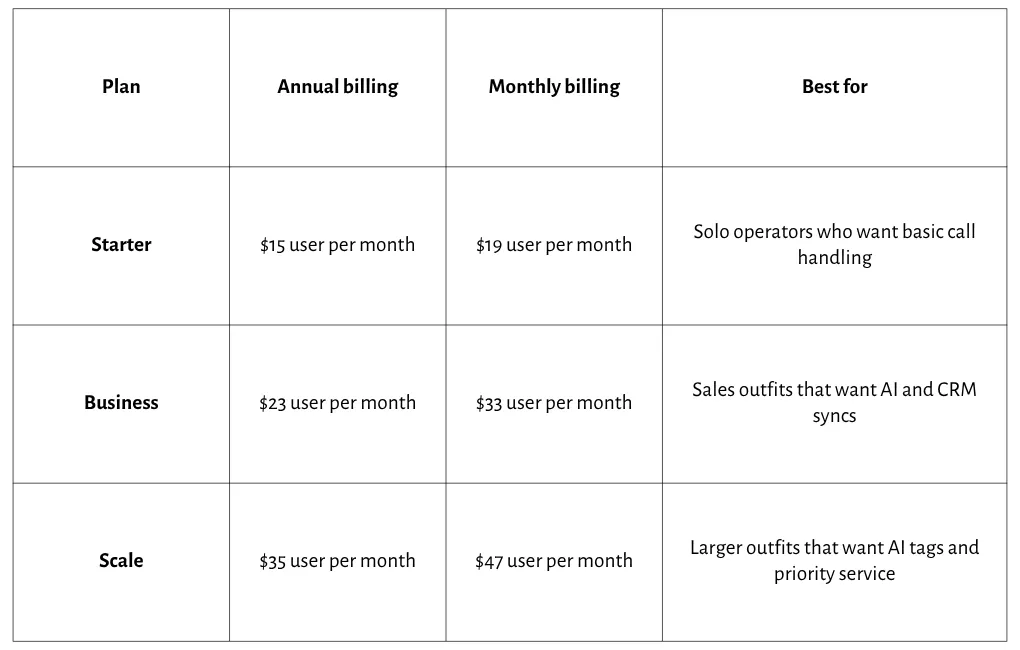
Indeed, the annual billing discount saves money. However, it locks you in for 12 months. If you’re a monthly buyer, you’ll pay 27% more for the same features.
While OpenPhone pricing appears as “transparent,” the service comes with tons of hidden charges that aren’t apparent unless you’re keen enough.
Here’s what you may not know about Quo plans right out of the gate.
1. The monthly plan costs 27% more than the annual plan
OpenPhone advertises $15, $23, and $35 per user per month. However, those prices only apply if you commit to a full year upfront. Month-to-month buyers pay $19, $33, and $47 per user per month.
While this is a common pricing practice with almost every VoIP provider, you won’t know how much it really costs unless you break down the math.
Think of small teams that want to test the service before committing. You’ll be charged a 27% surcharge. Meanwhile, solo buyers pay $48 extra per year on Starter. Small teams, on the other hand, pay $120 on Business plan, while larger teams pay $144 on the Scale tier.
2. Sona's 1,000 free credits expire after 10 calls
OpenPhone's pricing plans include the SONA AI agent. The catch, however, is that you only get 1,000 free credits per month.
One AI call uses 100 credits. So 1,000 credits means 10 AI-handled calls per month.
Need more? Credit packs start at $25 per month for 40 calls and climb to $199 per month for 600 calls. Past your pack limit, SONA AI charges overage fees of $0.45 to $1.00 per AI call.
With such charges, a single busy afternoon can wipe out the 10 free AI call allotments on Starter.
3. AI call summaries require the Business plan
On the Starter plan, AI call summaries only apply to Quo calls handled by SONA AI.
Want call summaries and transcripts for every call your reps make? You need the business plan at $23 per user per month.
And, you’ll need to pay an $96 extra per user per year to access the AI features and call summaries on calls you already make. Full call summaries for all calls are available only on Business and Scale.
The AI features on Starter barely qualify as useful.
4. Auto call recording is only available on the Business plan
Starter buyers get manual recording only. In other words, you must press a button to start recording. Miss a button press, miss the call recordings.
Automatic call recording starts with the business plan. And if you want to call recordings for coaching, QA, or compliance, pay $8 more per user per month to get them. For a 10-person team, call recordings cost an extra $960 per year with OpenPhone.
5. HubSpot and Salesforce integrations are only available in the Business plan
Sales and service teams who use HubSpot or Salesforce cannot sync on the Starter plan. CRM syncs require the business plan at $23 user per month, billed annually.
Pipedrive, Zoho, Attio, Jobber, and Gong also gate on Business. Therefore, small businesses using any major CRM pay the upgrade tax.
6. Phone menus cost $8 more per user per month
Basic phone trees like "press 1 for sales, press 2 for service" do not come on the Starter plan. Phone menus are only available on the Business plan.
OpenPhone competitors like iPlum bundle IVR at the base tier. Quo pricing plans, by comparison, push you up a tier for a feature buyers expect at the affordable entry point.
7. Advanced analytics are hidden in the Business plan
You cannot see call volume, response times, or rep activity on the Starter plan. Only basic analytics are available at $15 per user per month.
Advanced analytics and reporting are included in the Business plan. If you want oversight and more advanced features, you’ll need to pay an additional $96 per year. With OpenPhone, the core advanced features you expect at the standard level are available two tiers up, and they don’t come cheap.
8. Shared numbers cap at 10 users on the Starter plan
The starter plan lets you share a phone number among up to 10 paid users. Larger teams must upgrade to Business for unlimited shared phone numbers.
A 12-person service squad on one shared line pays $23 per user per month instead of $15. That’s $1,152 extra per year for one feature.
iPlum: A more affordable alternative to OpenPhone
Quo pricing suits users with low call volume and basic needs. For everyone else, the upgrade path gets expensive fast.
iPlum gives you the same key features for less money. Here's how iPlum stacks up against Quo pricing plans.
1. Transparent pricing with no hidden credit overages
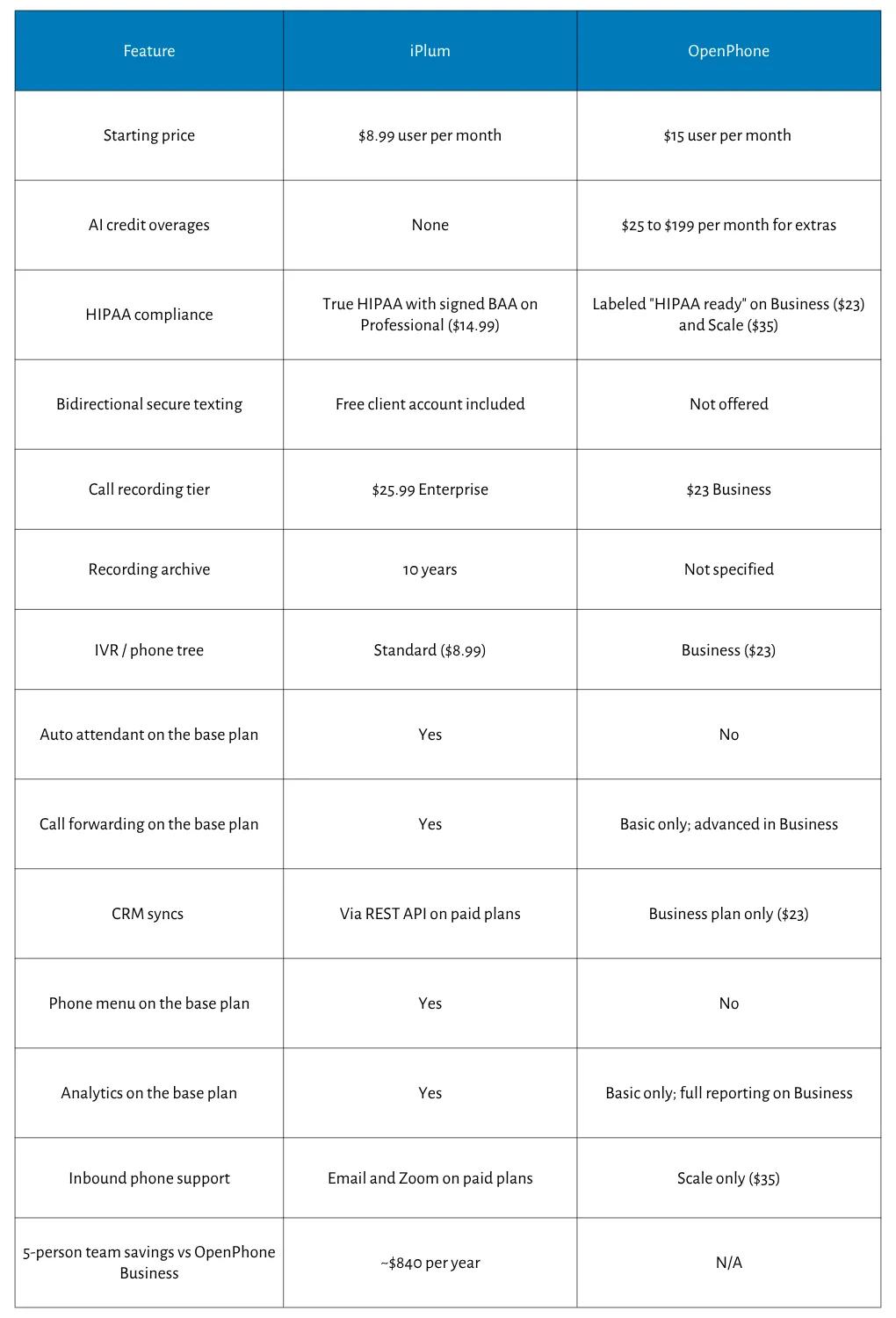
iPlum's Standard plan starts at $8.99 per user per month on annual terms. That’s 40% cheaper than Openphone's base-level pricing of $15 per user per month billed annually.
With iPlum, there are no surprise $25 credit packs when your AI agent allowance dries up. You pay a flat fee, and your phone systems work as expected across all iPlum phone system tiers.
2. HIPAA compliance at a lower tier
iPlum's Professional plan costs $14.99 per user per month. It bundles HIPAA compliance, a signed BAA, secure, encrypted texting, voicemail transcription, group messaging, broadcast text, and scheduled texts.
OpenPhone labels itself "HIPAA ready" only on Business ($23) and Scale ($35). Healthcare outfits pay $96 to $240 extra per year for the same compliance that iPlum offers at $14.99.
Speaking of HIPAA compliance, OpenPhone doesn’t offer true HIPAA compliance, unlike iPlum.
iPlum offers a free client account that enables bi-directional, secure texting, separate from standard SMS and MMS. It’s one of the few providers that offer this service on the market.
3. Call recording and 10 years of archiving at a lower price
iPlum's Enterprise plan costs $25.99 per user per month. It bundles call recording, recording consent announcements, and 10 years of call recordings and text archiving.
OpenPhone's automatic call recording starts at $23 per user per month on the Business plan. However, it doesn’t offer a comparable 10-year archive window for financial industry professionals.
4. Phone tree and auto attendant on every plan
iPlum offers an advanced phone tree, auto attendant (IVR), call forwarding, and extensions on its $8.99 Standard plan. Quo pricing, in comparison, locks phone menus behind the $23 Business tier.
A 5-person service outfit saves $840 per year on iPlum's Standard plan versus OpenPhone's Business plan for the same IVR setup.
5. Unlimited extensions per line
iPlum offers a single line with unlimited extensions that can point to multiple phones, users, or external numbers. OpenPhone bills per seat, so all user accounts carry the full price.
For growing teams on a shared inbound line, iPlum's billing model costs a fraction of OpenPhone's. The per-user model from OpenPhone forces payment for team members who will not use their own numbers.
6. Works on mobile, web, and browser
iPlum's Professional and Enterprise plans offer web calling and texting, so you can work from any device with an internet connection.
While both providers offer mobile apps, the iPlum app includes business-hours routing and auto-text replies at a lower tier.
iPlum vs OpenPhone pricing comparison
Here is how iPlum and OpenPhone pricing compare side by side.
Why iPlum beats OpenPhone on price
Openphone pricing hides the real cost behind a $15 headline.
Buyers who pick Starter end up paying $23 or $35 once they need auto recording, phone menus, HubSpot sync, or full AI call summaries. Add credit overages, extra-number-per-user fees, and automated SMS charges, and the monthly bill climbs past what small businesses budgeted.
iPlum skips the upgrade pressure.
The Standard plan at $8.99 gives you a working business phone system with phone tree, voicemail transcription, auto-replies, and business hours.
The Professional plan at $14.99 adds HIPAA, encrypted texting, scheduled messages, and web calling. Enterprise at $25.99 adds call recording and 10 years of archiving.
For small businesses that field patient calls, insurance inquiries, legal intake, or service dispatch, iPlum offers compliance-grade calling at half the price of OpenPhone's equivalent tier.
Openphone's pricing starts 40% higher than iPlum.
Ready to switch to iPlum?
OpenPhone's $15 price tag looks appealing until you add the upgrades needed to make the product useful.
Auto recording, CRM syncs, phone menus, and AI call summaries push will push you to the $23 business plan or higher. And then there’s the AI credit overages, $5 additional phone numbers fees, and automated SMS charges pile on top.
iPlum is all about affordability,
You pick a plan based on what you need: basic call handling at $8.99, HIPAA compliance at $14.99, or call recording at $25.99. All iPlum plans include phone tree, auto attendant, business hours, auto-replies, and voicemail.
For users who value unlimited calling, clean call handling, and predictable quo pricing competitors, iPlum is your go-to service.
Click the link below to sign up for iPlum today. Get a compliance-ready business phone system up and running in minutes, with no credit packs, upgrade traps, or hidden fees. Of course, you can cancel anytime.
You can also port your number out of Quo in a few steps.
Disclaimer: This article is intended for general informational purposes and may not reflect the most current features or capabilities of the products or companies mentioned. For the most accurate and up-to-date information, please refer to the official sources of each company.

