


%20(1).avif)
.avif)

Client calls are part of the everyday routine for attorneys.
And because client conversations shape cases, billing, and trust, it makes sense to record them.
But depending on where you—and your client—are located, recording that call could create a legal problem.
Several states require consent from everyone on the call. If you’re not careful, you could violate state law, strain client relationships, or face a complaint. And even experienced attorneys can run into trouble here, especially when calls cross state lines or happen on personal phones.
But you don’t have to second-guess every phone call.
You need to know what’s required and how to use the iPlum call recording phone system for lawyers to legally record calls with built-in consent announcements.
Table of Contents
1. What is dual-party consent, and why should you care?
2. Which states require dual-party consent?
3. The high cost of ignoring dual-party consent
4. How to ensure compliance without complicating your workflow
5. Why iPlum is the best phone system for secure, compliant call recording for legal professionals
6. Get a call recording solution built for attorneys
What is dual-party consent, and why should you care?
Recording calls sounds straightforward.
However, consent laws change the equation. Some states allow recording if one participant agrees. Other states require permission from everyone on the line. That difference is important to attorneys.
First, dual-party consent laws exist to protect privacy. On top of that, lawmakers want every caller to know when a conversation is being recorded.
One-party vs. dual-party consent
One-party consent means that only one participant can approve the recording. An attorney speaking with a client can record without announcing it, provided state law allows it.
In dual-party or all-party consent states, everyone on the call has to know the call is being recorded. Therefore, you must give a heads-up—usually through an audible announcement—at the start of the call
Who does this apply to?
These laws apply to more than just big firms.
If you're a solo attorney, litigator, mediator, in-house counsel, legal aid provider, paralegal, or part of a boutique practice, you're still responsible for following consent rules.
The size of your practice does not change your legal duty.
Independent professionals face the same recording requirements as large offices. State regulators do not lower the bar because a call came from a personal phone or a home office.
Ignorance offers no protection
You can’t claim you didn’t know or were confused. Good intentions do not cancel statutory requirements. Recording a call without proper consent can lead to fines, lawsuits, or disciplinary review.
Which states require dual-party consent?
Call recording rules aren’t the same across the country.
Dual-party consent is enforced at the state level, and the requirements vary from state to state. If you’re calling clients across state lines, you need to know where consent is required and how to handle it properly.
At the time of writing this, the following states require all parties on a call to give permission before recording:
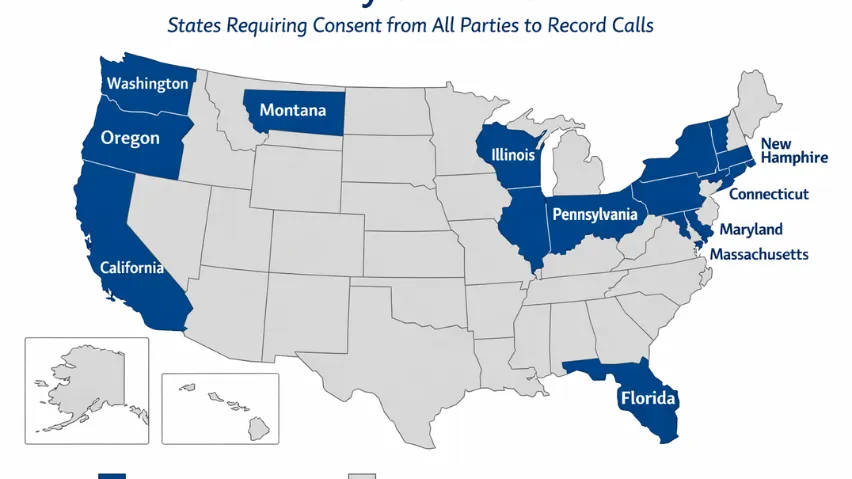
- California
- Connecticut
- Florida
- Illinois
- Maryland
- Massachusetts
- Michigan
- Montana
- Nevada
- New Hampshire
- Pennsylvania
As a rule of thumb, be sure to check the specifics for each state to know exactly what the law requires.
What if the caller and recipient are in different states?
In calls between states with different laws, things can get messy.
If you’re in a one-party state and your client is in a dual-party state, the safest move is to follow the stricter rule. That means always informing everyone at the start of the call that a recording is taking place.
The last thing you want to do is guess based on an area code or past habits. That’s not a good idea. Area codes don’t always reflect location, and laws can change.
Built-in recording announcements from iPlum take care of this for you. Every call starts with a standard message that alerts all participants.
That way, you don’t have to remember who’s in which state, or risk a violation just for picking up the phone.
The high cost of ignoring dual-party consent
Ignoring dual-party consent rules carries significant consequences. A single recorded call can trigger legal complaints, civil penalties, or suppression of evidence.
For attorneys, that exposure extends beyond fines. Ethics reviews and disciplinary action can follow.
Legal consequences
In dual-party states, recording without consent can lead to criminal charges, civil penalties, or both.
Depending on the state, that could mean fines, statutory damages, or even jail time in the most serious cases. And yes, attorneys have been sued for this.
Ethics complaints and bar reviews
A formal opinion from the New York City Bar in late 2025 emphasized that lawyers must remain mindful of the requirement for two‑party consent before recording client conversations.
A client who feels blindsided by a recorded call could file a complaint with the bar. That opens the door to investigations, professional discipline, and reputational damage.
Even if it doesn’t go that far, the time spent responding to a grievance is time you’re not billing.
Reputational fallout
Legal practices run on trust. If clients find out their calls were recorded without proper notice, you may not get the chance to explain that it was an oversight. In their eyes, you crossed a line.
The point is, call recording should protect your practice, not create more problems. That's why iPlum was designed to start calls with an automatic announcement. With iPlum, there’s no guesswork, and you can always protect your firm’s reputation.
How to ensure compliance without complicating your workflow
Knowing the rules is one thing. Applying them across every call is something else.
Moreover, you could understand what the law requires, but life can get in the way, on mobile devices, when you’re in between meetings, or juggling client matters across states.
That’s where things tend to fall through the cracks.
Common mistakes attorneys make
Even well-meaning attorneys run into trouble with call recording.
It’s not always a lack of knowledge. It’s usually a lack of process. These are the most common slip-ups that lead to compliance risk:
- Skipping the announcement: Jumping straight into the call without letting the other party know it’s being recorded.
- Assuming one-party consent applies: Forgetting that the other person may be in a dual-party state with stricter rules.
- Guessing location based on area code: Relying on caller ID, which may not reflect where the person actually is.
- Recording on personal phones: Blurring the line between professional and private communication, complicating discovery or privilege.
- No record of consent: Failing to document that permission was given, verbally or otherwise, leaves you exposed if questioned later.
- Manual compliance habits: Relying on memory or checklists instead of using tools that automate consent and logging.
Multi-state calling makes things harder
In a remote-heavy legal world, clients aren’t always local.
A California attorney might be on the phone with a client in Florida. A New York litigator could be deposing someone in Pennsylvania. The more jurisdictions involved, the harder it gets to manage consent rules manually.
And with caller ID masking or virtual numbers, it’s easy to lose track of who’s located where.
Why iPlum is the best phone system for secure, compliant call recording for legal professionals
Compliance isn’t something you want to patch together.
It needs to be built into the tools you use every day. iPlum is designed for legal professionals who don’t want to worry about state-by-state rules, recording disclosures, or storing sensitive client data on personal devices.
With iPlum, the basics of legal call recording are already covered.
Here’s what you get with iPlum call recording for attorneys:
Built for compliance in all 50 states
iPlum automatically applies the right rules, whether you're in a one-party or dual-party consent state.
Recorded calls begin with a standard voice announcement to let everyone know that the recording is in progress.
You don't have to remember to say it. You don't have to track who heard it. The system does that for you, on every call.
Automatic notices and secure storage
Each recorded call includes a built-in consent notice, so you're covered in states that require it.
In addition, the platform stores recordings in an encrypted vault, separate from your phone’s internal storage. That way, they’re within your firm’s professional environment and help preserve attorney-client privilege.
Because iPlum doesn’t store recordings on your personal device, you reduce the risk of subpoenas pulling in private phone data. Plus, the platform is HIPAA- and SOC 2-compliant and supports end-to-end encryption.
Access from anywhere, without mixing personal data
You can manage recordings, voicemails, and call logs from the iPlum portal or mobile app.
All professional communication remains in one secure channel. Your clients never see your personal number. In addition, your firm's records never mix with your private call history.
Admissible records with a chain of custody
iPlum recordings include metadata such as timestamps and participant information.
That way, you have a solid record of who was on the call, when it happened, and how the recording was created. These details are vital if the file is ever used in discovery, court, or internal firm documentation.
Easy access to logs and billing support
Besides helping you comply with dual-party consent requirements, iPlum also creates detailed call logs separate from your personal phone records.
You can track which clients you spoke with, how long each call lasted, and export that data to reconcile billable time at the end of the month.
Built for solo attorneys or firm-wide deployment
If you’re part of a larger practice, iPlum’s business account allows you to manage multiple users.
Each associate gets a secure line on their own device, and everything is managed from a central console with consistent compliance settings.
Get a call recording solution built for attorneys
Client calls are an opportunity—and a liability— for attorneys if recording laws aren’t followed.
So, if you’re an attorney, you can’t afford to guess which rule applies or rely on memory for compliance.
iPlum gives you a better way to record calls legally, protect attorney-client privilege, and keep client communication separate from your personal phone.
Explore how iPlum makes legal call recording simple, secure, and built for the way attorneys work.
Learn more about iPlum’s legal call recording solution

