


%20(1).avif)
.avif)
.webp)
At iPlum, we get this question many times.
Do I need a BAA for my phone?
So much so, we created this in-depth guide to cover everything you need to know about BAA for phone service.
The straight answer is, it depends.
You need a BAA for your phone if you use it to discuss, record, or store patient information.
In short, anything that qualifies as Protected Health Information (PHI) under HIPAA. PHI here includes calls about treatment, follow-up texts with test results, or voicemails that mention a patient’s name and condition.
Conversely, you don’t need a BAA if your phone line never touches PHI. For example, a receptionist confirming appointment times or sending general office reminders.
The moment you exchange identifiable health information, though, your phone system becomes part of the compliance chain.
That said, you must understand when you cross that line to protect your practice from fines and data breaches.
In the sections below, we’ll explain how BAAs work and when they’re required. We’ll also tell you what to look for in a phone service that claims to be HIPAA compliant and signs BAAs.
Table of Contents
2. Why is BAA for phone service important?
3. When do you require your phone service to have a BAA?
4. When can you use a phone system without a BAA?
5. What happens if you don’t have a BAA?
6. What should you look for in a HIPAA-ready phone system?
7. BAA for phone service: frequently asked questions (FAQs)
8. How to get a BAA for your phone line?
9. Best HIPAA-compliant phone service with BAA
What is BAA?
For starters, BAA is an acronym for Business Associate Agreement.
It’s a legally binding document required under the Health Insurance Portability and Accountability Act (HIPAA). BAA defines how a third-party service provider manages, stores, and protects patient information shared by a healthcare organization.
In simple terms, it’s a contract that says, “We both understand our responsibility to protect Protected Health Information (PHI).” The agreement also specifies what happens if data is lost, misused, or exposed. Moreover, it holds the vendor accountable for following HIPAA’s privacy and security rules.
Any covered entity, such as a clinic, hospital, or private practice, must sign BAAs with any partner that handles PHI. This includes phone service providers, cloud storage vendors, EHR systems, billing software, and texting platforms.
A BAA isn’t a technical feature you can turn on or off. It’s a legal framework that shows a commitment by involved parties to observe compliance. Without it, even a secure system cannot be considered HIPAA compliant.
Why is BAA for phone service important?

Phone calls and text messages are at the center of all healthcare providers' patient communication. And because these conversations include PHI, they fall under HIPAA rules.
Here’s why you need to ensure your phone service signs a BAA.
It protects the patient’s privacy
A signed BAA confirms that your phone service uses proper safeguards such as encryption, secure voicemail, and controlled data access to protect PHI. It also prevents unauthorized staff or third parties from listening, recording, or sharing sensitive details.
In short, it’s the foundation of privacy protection in patient communication.
It defines responsibility
A BAA clearly assigns duties between the healthcare provider and the vendor. Both agree to follow HIPAA standards, manage data properly, and report breaches quickly. Without a BAA, any violation caused by your phone vendor becomes your liability.
It supports HIPAA compliance
HIPAA compliance extends beyond EHR systems. It applies to every channel that transmits PHI, including phone calls and text messages. A BAA demonstrates that your communication system meets privacy and security requirements set by law.
It prevents penalties
Violations involving unsecured communication can attract serious fines and investigations. Having a signed BAA shows you took preventive action, which may reduce the risk of heavy penalties. More importantly, it protects your reputation with patients and regulators alike.
It builds patient trust
Patients expect confidentiality when sharing sensitive details. Using a phone system covered by a signed BAA reassures them that their privacy is crucial. Over time, that trust strengthens patient relationships and reinforces your reputation as a responsible provider.
When do you require your phone service to have a BAA?
There are times when you must use a phone system that follows HIPAA telephone rules. Here are a few examples.
When your calls include PHI
You need a BAA if your calls include patient information that identifies an individual and relates to health, treatment, or payment. We’re talking about conversations that involve discussing lab results, medication changes, or billing questions over the phone. Even routine follow-ups can contain PHI once you mention names or conditions.
When your texts carry sensitive details
Texting is a convenient way to share patient information. But it’s also risky.
Any text that includes appointment details, lab updates, or clinical advice qualifies as PHI. You need a BAA if your messaging app stores or transmits that information through its servers.
By the way, standard texting platforms like Google Voice or WhatsApp don’t meet HIPAA standards because they lack encryption and won’t sign BAAs.
When voicemails or recordings contain patient information
A voicemail message that says, “Your test results are ready,” or “We’ve adjusted your prescription,” contains identifiable medical details. Therefore, if your phone system stores or archives such messages, you must have a BAA to ensure secure handling and proper access controls.
When staff communicate internally about patient care
HIPAA compliance also applies to internal discussions among doctors, nurses, and administrative staff. If your team uses a shared phone line, app, or cloud-based system to coordinate patient care, that system must be covered by a BAA.
The HIPAA privacy rule applies even when communication happens within the same organization.
When your vendor has access to stored data
You need a BAA if your phone provider can access, manage, or back up your communication data. For instance, cloud-hosted systems that handle call logs, transcripts, or stored messages are considered business associates under HIPAA. The agreement makes sure they follow the same security standards you’re bound by.
When can you use a phone system without a BAA?
Not every phone call in healthcare triggers HIPAA compliance. Some conversations are purely administrative and don’t involve patient details. In such cases, you can use a regular phone system without worrying about signing a Business Associate Agreement.
Here are everyday situations where a BAA isn’t required.
When calls don’t mention PHI
You can use a standard phone service if your calls never include identifiable health information. Examples include general office updates, business partnerships, or vendor coordination.
When sharing general information
It’s fine to use non-compliant systems for calls or texts that provide generic information, such as directions to your office, holiday hours, or parking details. Those messages don’t identify a specific patient and therefore fall outside the HIPAA security rule.
When marketing or outreach is non-personal
You don’t need a BAA for broad marketing or public awareness campaigns. For example, sending an SMS blast announcing a new service or hosting a wellness event doesn’t count as PHI communication.
When using personal phones for internal coordination
If staff use personal phones to coordinate schedules, confirm shift changes, or handle non-patient matters, no BAA is needed. However, you should not use the same devices to share or store patient details through standard calling or texting apps.
When the vendor never accesses your data
A BAA isn’t required if your phone provider doesn’t process, store, or manage any communication data. For example, a standard landline carrier that only transmits calls without archiving or logging content isn’t considered a business associate under HIPAA.
What happens if you don’t have a BAA?
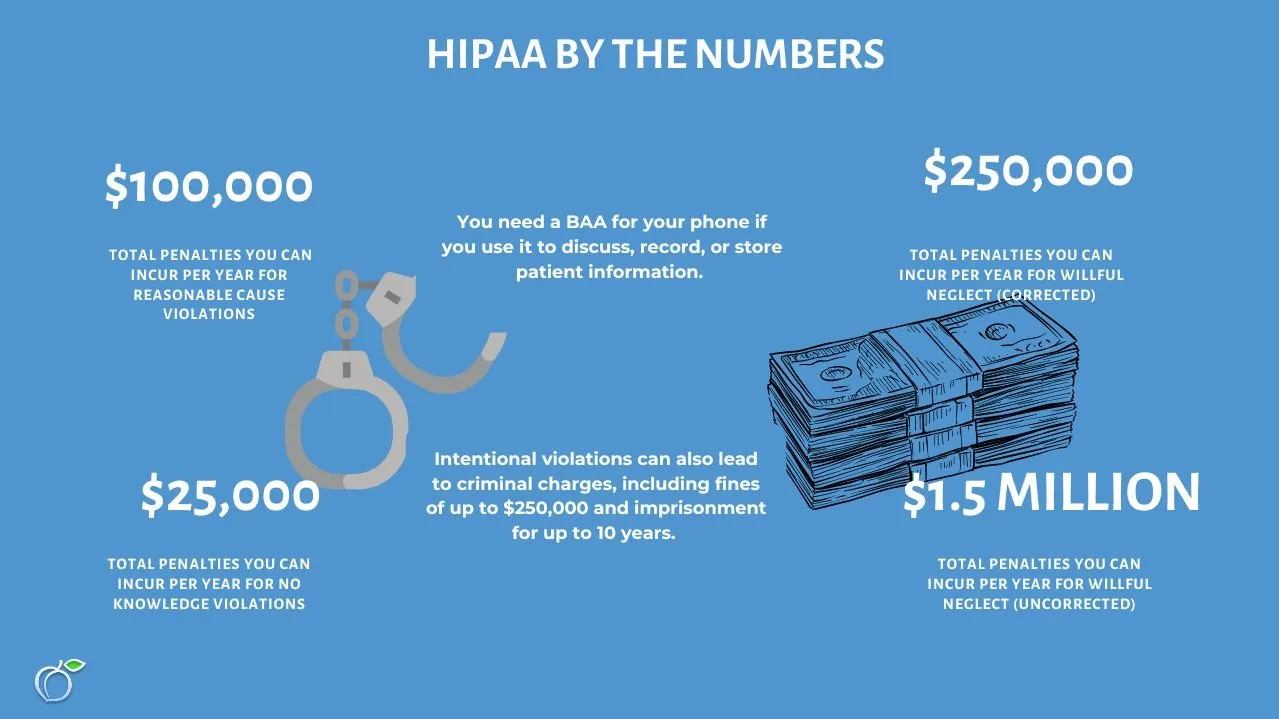
When you share or store sensitive data through a phone service that doesn’t sign a BAA, you’re not offering HIPAA-compliant services.
And, this exposes your practice to serious legal and financial risk. Plus, regulators treat it as a violation, even if no data breach occurs.
Here’s what it means if you don’t use a BAA.
You violate HIPAA rules
HIPAA requires every healthcare provider to have written agreements with vendors that manage PHI. Therefore, using a phone system that stores or transmits PHI without a BAA counts as non-compliance.
As a result, the Office for Civil Rights (OCR) can investigate, audit, and penalize your organization for failing to follow the law.
You face civil penalties
Fines for missing or unsigned BAAs range from $100 to $50,000 per violation, depending on the level of negligence. Worse still, the annual maximum can reach $1.5 million for repeated offenses.
Remember, small practices aren’t immune. Stats show that the OCR has fined clinics thousands of dollars for using unsecured email or texting platforms.
You carry full legal liability
Without a BAA, the entire responsibility for protecting PHI falls on your shoulders. If your vendor mishandles data, you cannot shift the blame. You must report the incident, pay the fines, and notify every affected patient. The law doesn’t excuse ignorance or good intent.
You increase your risk of data breaches
Vendors that refuse to sign BAAs usually lack HIPAA-grade safeguards like encryption, secure backups, and access control. The gap creates an open door for unauthorized access or hacking.
Once PHI leaks, you face mandatory breach reporting and possible class-action lawsuits.
You damage your reputation
A privacy breach does more than attract fines. It erodes patient trust. And when patients can trust you, they’re likely to switch providers. You don’t want that.
What should you look for in a HIPAA-ready phone system?
Not every phone service marketed to healthcare professionals meets HIPAA standards.
A good number of providers promise security but fail to back it up with proper documentation or signed agreements.
So, before choosing a vendor, confirm that the system aligns with HIPAA regulations and can protect your patients’ information as well as your organization’s reputation.
Here’s what to keep in mind.
It must offer and sign a BAA
Start by confirming that the provider actually issues written business associate contracts. These contracts prove the company understands its role in safeguarding PHI.
A compliant phone service always signs a BAA before transmitting or storing data on behalf of a covered entity’s workforce or an organized health care arrangement.
It must use strong encryption
The system should encrypt calls, texts, and voicemails end-to-end. Encryption ensures unauthorized parties, including internet service providers, can’t intercept sensitive data.
When encryption is missing, even a small breach can escalate into full-scale HIPAA violations that attract fines and corrective actions.
It must store data in the United States
Choose a provider that stores all communication data on U.S.-based servers with detailed audit trails. Local storage ensures your practice stays within federal jurisdiction and avoids cross-border privacy risks.
Providers that process or store data overseas can create compliance conflicts under HIPAA regulations.
It must provide account control
Your phone system should support multiple users with role-based permissions. Each employee must have separate credentials to prevent unauthorized access.
Robust account management ensures that the covered entity’s workforce operates securely and that PHI stays compartmentalized between work and personal numbers.
It must archive data for compliance audits
HIPAA requires traceability. A compliant phone service, therefore, must keep call logs, messages, and voicemails for several years to support audit requests.
In addition, long-term archiving protects your practice during investigations or disputes involving HIPAA violations and other regulatory reviews.
It must secure recordings and message retrieval
If your system records calls or transcribes voicemails, those files must remain encrypted and easily retrievable for audits.
Secure recording storage also matters for insurance verification, billing follow-ups, and financial transaction services that tie into health plans or other financial transaction services.
It must include automatic logout and authentication
Look for automatic timeouts, PIN entry, or biometric sign-in features. These prevent unauthorized users from accessing stored PHI when a device is misplaced.
Moreover, such safeguards align with the administrative and technical standards defined in HIPAA regulations.
It must separate business and personal communication
A HIPAA-ready phone system lets you manage professional calls and texts separately from personal ones. The separation simplifies compliance for staff who process electronic funds transfers, handle consumer conducted financial transactions, or discuss health plan premiums with patients.
Verify beyond marketing claims
Some vendors use “HIPAA-compliant” as a buzzword. Therefore, always verify their policies, encryption standards, and incident-response plans in writing.
In addition, request proof of compliance before you sign anything. The point is, true compliance readiness requires structure, documentation, and enforceable accountability through proper business associate contracts.
BAA for phone service: frequently asked questions (FAQs)
How can I make my phone calls HIPAA-compliant?
To make phone calls HIPAA compliant, use a provider that signs a BAA, encrypts all communication, stores data in the U.S., and limits access to authorized users only.
Do all phone providers sign BAAs?
No. Most consumer phone services, such as Google Voice or WhatsApp, don’t sign BAAs. Only specialized healthcare-ready vendors like iPlum, Spruce Health, or RingCentral offer legally binding HIPAA agreements.
Can I use my iPhone or Android’s default dialer for patient calls?
No. Default dialers lack encryption and secure storage. They don’t meet HIPAA requirements or sign BAAs, so you must route patient calls through a compliant phone app or service.
Is VoIP secure enough for HIPAA?
VoIP can meet HIPAA standards only when encrypted, monitored, and covered under a signed BAA. Regular VoIP services without these controls create privacy gaps and compliance risks.
What’s the difference between a secure phone line and an encrypted texting app?
A secure phone line encrypts calls and voicemails in transit. An encrypted texting app secures written messages and attachments. Both require a signed BAA for HIPAA compliance.
How long should I store call recordings or messages?
Healthcare providers should retain communication records for six to ten years, depending on state rules. Long-term archiving ensures audit readiness and protection during HIPAA investigations.
Who is responsible if a vendor with a BAA has a breach?
Both parties share responsibility. The vendor must report and contain the breach, while the healthcare provider must notify affected patients and document compliance actions under HIPAA.
How to get a BAA for your phone line?
The HIPAA privacy rule requires every healthcare practice to ensure that vendors handling PHI follow strict safeguards. Therefore, getting a BAA is the first step toward protecting your reputation and your patients.
But how do you get a BAA for your phone number? Here’s how:
Step 1: Determine if your communication involves PHI
Start by reviewing how your organization uses phone communication. Do you share lab results, discuss medications, or confirm treatment plans over the phone?
If your calls or messages include identifiable patient data, you must use a system that signs a BAA. Remember, internal communication between staff or such persons acting on your own behalf falls under HIPAA obligations.
Step 2: Ask your current provider if they sign BAAs
Contact your current void provider or phone company. Ask if they’re willing to sign a BAA and provide documentation proving HIPAA compliance.
Keep in mind that a significant percentage of phone companies that serve general consumers, including Google Voice, don’t meet this requirement and leave your healthcare practice exposed to compliance risk.
Step 3: Review their HIPAA compliance documentation
A compliant vendor should share proof of encryption standards, U.S.-based data hosting, and security policies covering mobile devices and network access.
Also, read their documentation carefully to confirm how they handle phone calls, voicemails, and stored communication. Any gaps can signal a major security risk to your practice.
Step 4: Switch to a compliant provider if needed
If your current system won’t sign a BAA, move to a HIPAA-compliant alternative.
For example, switching from Google Voice to iPlum gives your healthcare practice secure VoIP provider tools with encrypted texting, call recording, and long-term archiving.
It’s the same step many hospital laboratory teams and private clinics have taken to protect PHI and medical records.
Step 5: Review, sign, and store the BAA
Once you select a compliant provider, read the agreement carefully before signing.
Be sure to keep a digital copy of your compliance records because inspectors may ask to see these signed BAAs as evidence that your practice management systems meet the HIPAA privacy rule during audits.
Step 6: Train your staff on proper use
After signing, train all staff on how to use the phone system responsibly. While at it, emphasize secure phone calls, encrypted texting, and proper mobile device handling.
A signed BAA protects your organization only when every user follows HIPAA’s communication standards.
Best HIPAA-compliant phone service with BAA
iPlum ticks every box you’d expect from the best HIPAA-compliant phone service with a BAA.
First, it signs a BAA with healthcare providers and uses end-to-end encryption for all calls, texts, and voicemails.
In addition, each account includes a dedicated business number on personal phones, allowing staff to handle patient communication safely.
On top of that, the system also offers encrypted texting, 10-year data archiving, and U.S.-based servers that meet HIPAA storage requirements.
Meanwhile, iPlum’s built-in auto-attendant, extensions, and voicemail transcription make it easy for clinics to manage patient calls efficiently.
The best part?
iPlum’s HIPAA compliance plan starts at $14.99 per month—one of the most affordable in the market.
Click the link below to enjoy HIPAA-compliant calling and texting, complete with a signed BAA.
Disclaimer: This article is intended for general informational purposes and may not reflect the most current features or capabilities of the products or companies mentioned. For the most accurate and up-to-date information, please refer to the official sources of each company.

